

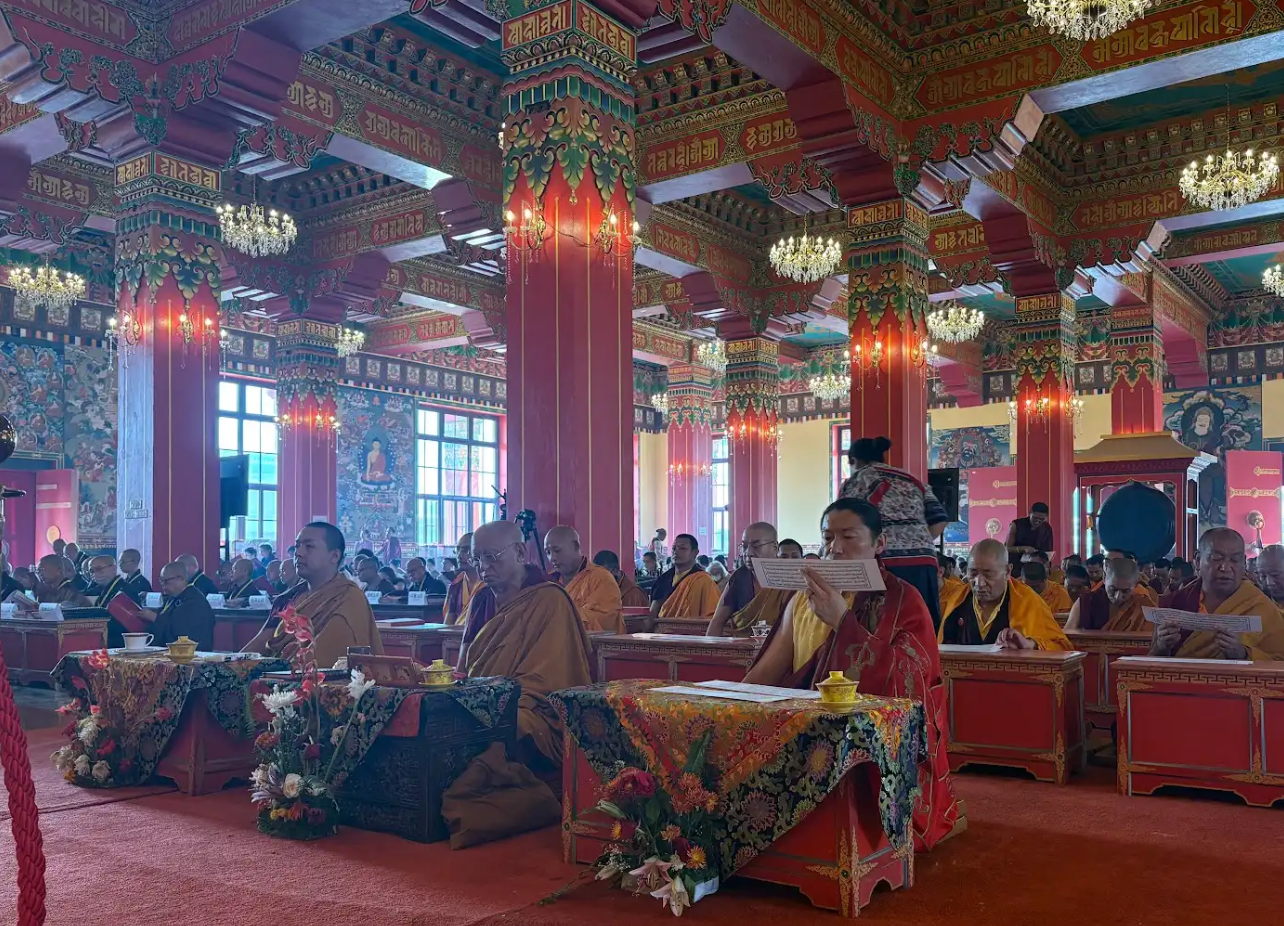
This past November, the Thousand Buddha Temple in Lumbini marked its inaugural anniversary with an unprecedented celebration: the first multi-tradition recitation of the Buddha's words. Chokyi Nyima Rinpoche brought together lay and monastic practitioners from around the world for a simultaneous recitation of the Buddha's words across all major Buddhist traditions—the Theravada Pāli Canon, the Mahayana Chinese Dazangjing, and the Tibetan Kangyur. The recitations were conducted in six languages: Pāli, Chinese, Tibetan, English, Mongolian, and Vietnamese. Most significantly, it was the first time 84000's collection of English-translated sutras to date had been recited in full. Three daily recitation sessions alternated with teaching sessions, all languages echoing simultaneously across the Buddha's birthplace.
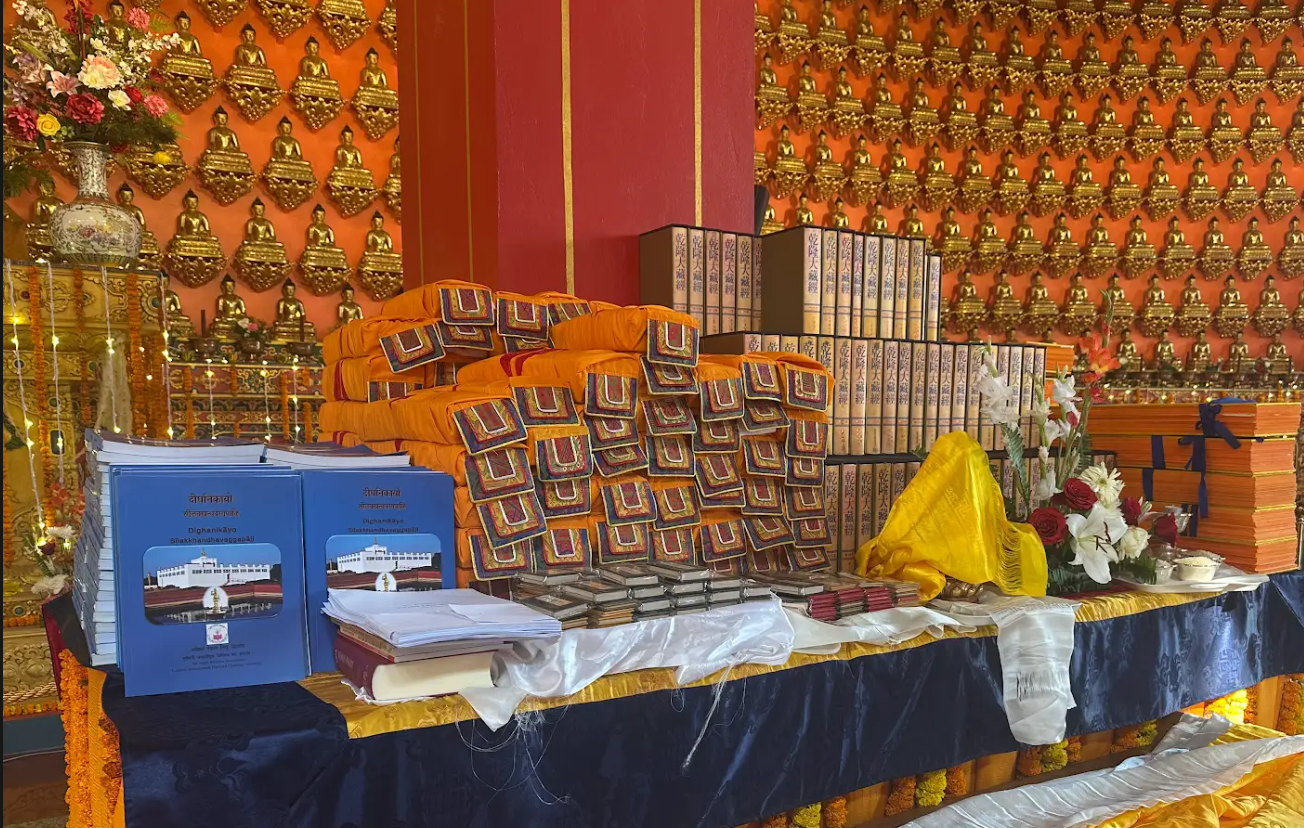
When I first learned months earlier that Chokyi Nyima Rinpoche planned to organize this recitation, I was utterly in awe. A profound inspiration and a powerful call to unity—bringing everyone into shared practice while creating space for different traditions to understand one another more deeply.
Five months and much preparation later, I was on my way to Kathmandu, then an eleven-hour bus ride to Lumbini, the very place where Prince Siddhartha was born.
The first day of the recitations fell on Lhabab Düchen, a major Buddhist festival celebrating the Buddha's return from the heaven realms, where tradition says he had spent months teaching his mother, who died shortly after his birth. Monastics and lay practitioners carried the sutras as they circumambulated the Maya Devi Temple and the Thousand Buddha Temple. Speeches by Rinpoche and venerable representatives from different traditions set the tone for this historic gathering. Then the resounding began, voices together like a living orchestra, each word a heartbeat of devotion echoing through the halls.
Participants came from all over the world, from as far as Ghana, Kazakhstan, and Switzerland. What also struck me was the effect on the local community. As the recitations continued or as Chokyi Nyima Rinpoche offered teachings, refuge, and empowerment, a steady stream of local visitors quietly circumambulated the hall. Indian and Nepali tourists, Tibetan pilgrims, families from nearby villages, students in school uniforms—all were gently drawn in by the atmosphere. It felt like the most natural form of outreach, planting seeds of curiosity and connection that might one day blossom into deeper engagement with the Dharma.
While most participants had prepared for months to attend, some stumbled upon the event by chance. A solo trekker wandered in and stayed for days, reciting the Buddha's words. A young Korean pilgrim who had planned Lumbini as her final stop found herself unexpectedly welcomed with hot meals and joyfully joined the recitation.
Reciting the Buddha's words is one of Buddhism's oldest traditions. Long before anything was written down, the teachings survived through recitation alone—memorized, repeated, passed from teacher to student across generations. Even after the words were eventually committed to text several hundred years later, the practice of communal recitation continued. Monasteries still gather regularly to recite the complete canon. For me, this was an incredible opportunity to participate in this ancient tradition—and though I've been part of the 84000 team for years, it was the first time I had a whole week to simply immerse myself in reading the Buddha's words. My engagement with the texts had mainly been practical—finding quotes for articles and sharing excerpts with partner organizations; however, with this opportunity, I got to read sutras I had never read before. As I recited using the 84000 mobile app, I kept taking screenshots of passages that stopped me in my tracks.
As I recited alongside hundreds of others reading in English from 84000 publications, the responses amazed me. The recitation worked beautifully in its simplicity. Each person received an assigned packet of sutras—typically three shorter texts and one longer work or section, totaling around 200 pages. Everyone recited their portions simultaneously. The hall filled with voices, each reader engaging their own passage while contributing to the collective whole. One participant became absorbed entirely in sections on the hell realms. Another spoke about the heaven realms with sparkles in her eyes. Someone who read part of the Stem Array sutra asked for the link to the complete text—it was so fascinating, they said, it felt like reading Star Wars. Another participant sought chapter 7 of a sutra the next day after finishing chapter 6, eager to find the answers promised there. Many were reading these sutras for the first time and finding them deeply relatable, reflecting on their own experiences and deepening their understanding. Every interaction reminded me why 84000's mission—making the Buddha's words freely available in English—matters so deeply.
This event was made possible through the vision of Chokyi Nyima Rinpoche and the dedication of the organizing team. You can also find out more about Chokyi Nyima Rinpoche’s teachings and events at DharmaSun.
The recitation of 84000's English translations represents years of collaborative work by our translation team and tech team, supported by donors and patrons who believe in preserving and making the Buddha's words accessible. This gathering demonstrated the value of that work—bringing together practitioners from diverse backgrounds to engage directly with these ancient teachings.
The Lumbini recitation exemplified an unbroken transmission stretching back over two millennia. From the first disciples who memorized the Buddha's teachings, to the monastics who preserved them through oral transmission, to this gathering in the Buddha's birthplace, where participants used printed texts, laptops, and mobile apps to read English translations—the methods evolve while the practice continues. The Dharma persists not only through preservation but through active engagement, as evidenced by participants ranging from long-time practitioners to those who encountered these teachings by chance. The work of 84000 in translating these texts into English is part of this ongoing transmission, making the Buddha's words accessible to new audiences and ensuring these teachings remain available to future generations.
Exploring the sūtras we recited at 84000 was a profound experience. All of these texts are freely available in English, open to anyone, with no paywalls or subscriptions. Each translation is the result of careful scholarly work—translation, editing, peer review—and the essential technical work that makes digital publication possible. The meticulous effort behind these translations makes it possible for the Buddha’s words to be shared and preserved for the future. Each sūtra is a window into centuries of wisdom, now accessible to all. It’s inspiring to see how these efforts allow the teachings to continue bridging generations and cultures, keeping the Dharma alive in the modern world.
Thank you for joining us on this journey! Start exploring the sūtras today, follow us on social media, and join our upcoming online events. Support our work and be part of the Recitation in Lumbini next year—experiencing it firsthand is truly unforgettable.
May the Buddha's words continue to flourish and benefit all. In these challenging times—with wars, disease, isolation, and struggles with mental well-being—the teachings are more relevant than ever. They address the root of suffering rather than offering temporary fixes, providing clarity, insight, and lasting benefit.
For some highlights from the event click here.
Author: Ushnisha Ng