When a reader encountered derogatory language toward women in the Kangyur, they wrote to ask why it's there. Have a question about a passage in one of our translations? We'd love to hear from you.
.png)
The Kangyur contains more than 60,000 pages of teachings—texts composed across centuries, in different cultural contexts, for different audiences. Reading them closely means encountering passages that inspire, passages that puzzle, and sometimes passages that trouble. That kind of close, honest engagement with the texts is exactly what we hope for.
"Ask the Translator" is a new series in which members of our translation and editorial team respond to questions from readers. Whether you're working through a difficult concept, puzzling over a specific passage, or sitting with something that doesn't sit right, we invite you to write to us at [email protected].
We begin with a question from H.Y.W., a practitioner who wrote to us about gender language in one of our translations, and a response from Annie Heckman, a member of our editorial team.
While reading a passage in one of our translations that contained language reflecting historical attitudes that present women in a negative light, a female practitioner wrote to us with the following concern:
"I'm a young and new practitioner, and when I read the following lines from The Sutra of the Sublime Golden Light:
'May all women become males,
Heroic, with sharp minds and great intelligence.
May they all practice the bodhisattva's path
And be dedicated to accomplishing the six perfections.'
–Toh 555, 4.99
I feel a strong sense of discomfort and unease as a female practitioner. Although gender is an illusion and emptiness is form, form is emptiness, I do find it unnecessary to maintain the historical karma of misogynist patriarchy. Women and all the enlightened yogini had suffered enough to tell us that attaining enlightenment has nothing to do with gender, though we are bound by external dominant societal pressure. I kindly request a revision of this passage to be more non-dual and neutral, in order not to extinguish the fire of the yogini's aspiration to attain buddhahood.”
— H.Y.W.
Thank you so much for reaching out about this passage. It's heartening to know that our translations are being read so closely, and it makes sense for us as active readers and practitioners to pause and question language that goes against the grain of our values.
While our commitment to translating the texts as faithfully as possible limits us from revising the passage you've highlighted, we have carefully considered this issue. To do that, I'd like to share the principles that guide how we approach the texts:
The goal of 84000 is to translate the canonical texts into modern languages as accurately as possible. While our translators and editors strive to use language that is as inclusive as possible and free from added bias in terms of gender, race, or otherwise, we feel it would be inappropriate to actively change or modify the original content of these works.
Our mission is to preserve and make available the literary heritage of the Tibetan Buddhist canon in its entirety, so that modern readers have direct access to this corpus of primary sources. We do not think it is our place to omit or alter passages that are controversial or troubling. We work to make the texts available in English while leaving it to contemporary teachers and students of Buddhism to interpret and use them as they find most helpful and appropriate. We are aware that some passages reflect attitudes and beliefs that modern readers will find biased, repressive, or plain wrong. These passages reflect the cultural contexts in which they emerged, and we recognize that some of these attitudes may still exist today in certain contexts.
Attitudes toward gender are among the most obviously discordant features of some works in the Kangyur. In some texts, statements about the undesirability of being a woman may reflect the lack of freedom that women had to determine the course of their own lives and pursue a spiritual path. Certain statements may also reflect the fact that in some cases, the Buddha was preaching to an audience of celibate men, and teachings on the undesirability of the female body may be a reflection of that context. In other cases, however, such statements appear to be expressions of plainly misogynistic attitudes that modern readers will simply find unacceptable. At the same time, a significant number of Kangyur texts take the clear position that women have the same potential to practice and attain realization as men, and even that gender differences are illusory and have no real basis in truth. There are passages in a number of texts where women are presented as highly capable spiritual agents who embody the very state of awakening.
The collection of texts in the Kangyur represents a variety of views that readers must navigate and evaluate based on their own background and beliefs. That different things were taught to different audiences at different times is an explicit feature of the Buddhist scriptures, and the commentaries discuss in great detail the distinction between statements of definitive truth on the one hand and provisional teachings tailored to specific conditions, times, and audiences on the other. Our goal is simply to translate these texts as accurately as possible so that readers of diverse backgrounds can decide for themselves what might be gained from their study.
Fortunately, many Buddhist traditions have maintained a living lineage of teachings that can guide people within the context of their own culture and conditions. We encourage our readers to discuss the meaning and relevance of this literature with teachers of the living tradition.
As indicated above in the language on our mission, some of these works contain passages that appear out of step with gender parity but can be contextualized in terms of helpful contexts or skillful means, and others we cannot reasonably defend as such, but we still present them to share the richness of our textual heritage with full transparency rather than suggesting that one should adopt all the many attitudes and beliefs contained therein. When we consider the many different places, times, and contexts in which the Dharma has flourished, it perhaps makes sense that our texts have reflected a wide range of attitudes toward women.
As a woman learning in this tradition, I'm grateful to see the full range of these attitudes represented in our translations because of the transparency it provides about our shared Buddhist heritage (and because it gives me a sense of some of the obstacles women before me have faced), but of course it's never pleasant to come across something with discouraging attitudes about women when we're reading for inspiration! I hope that when you do find inspiring passages along the way, you will share them to promote the aspiration that you are so diligently pursuing.
I hope that my words are helpful, and again, I thank you for your close reading and care for the tradition of preserving the words of the Buddha.
— Annie Heckman, Research Editor & Translator at 84000.co
Have a question for our translators? Write to us at [email protected]
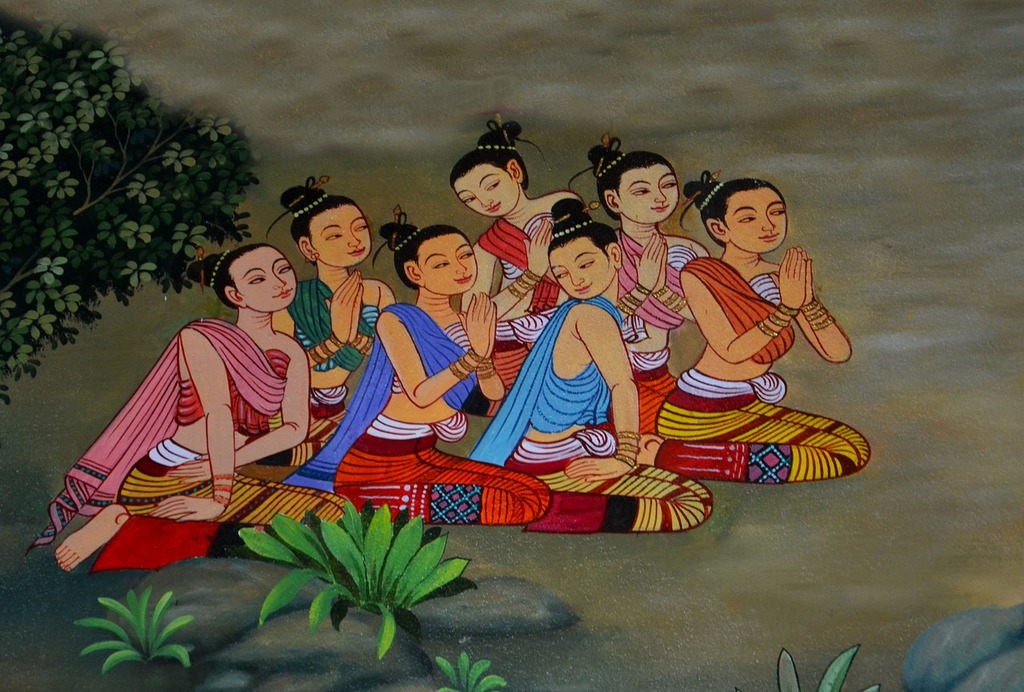
While there are many passages in the canon that reflect derogatory attitudes toward women, there are other texts that take a markedly different position: affirming that women have the same capacity as men to practice and attain awakening, and at times placing women at the very center of the narrative as realized teachers in their own right. The following sūtras offer a starting point for readers who want to explore this theme further.
The Questions of the Girl Vimalaśraddhā (Toh 84). King Prasenajit's daughter visits the Buddha with five hundred women and receives twelve sets of teachings on bodhisattva conduct. The sūtra's introduction surveys this theme across the canon more broadly.
The Prophecy Concerning Strīvivartā (Toh 190). A laywoman reveals herself as an advanced bodhisattva and engages Subhūti in a profound exchange, ultimately receiving a prophecy of future awakening.
The Prophecy of the Girl Candrottarā (Toh 191). A girl born radiating golden light evades a crowd of suitors by rising into the air, where she teaches on the futility of desire and is prophesied to attain awakening.
The Prophecy of Kṣemavatī (Toh 192). Queen Kṣemavatī explains to the Buddha that her royal status is the fruit of past good deeds, leading to a teaching on karma and a prophecy of her own awakening.
The Prophecy of Śrī Mahādevī (Toh 193). Set in the buddha realm of Sukhāvatī, this sūtra recounts how Śrī Mahādevī's devotion to past buddhas led to a prophecy of her future enlightenment.
The Questions of Gaṅgottarā (Toh 75). A laywoman's dialogue with the Buddha on the illusory nature of all phenomena, including herself, reveals that countless past buddhas have taught this same discourse to women bearing her name.
Aśokadattā's Prophecy (Toh 76). A king's daughter who refuses to bow to senior monks defends the bodhisattva path in verse, prompting her father's outrage and, ultimately, a prophecy of her awakening.
The Questions of Vimalaprabhā (Toh 168). The bodhisattva Vimalaprabhā vows to take rebirth as a woman across many future lives, in some as a queen or princess and others in difficult circumstances, in order to liberate other women, and is then prophesied to found and protect the kingdom of Khotan, including a future life as a Buddhist nun who defends it during an invasion.
The Teaching of Vimalakīrti (Toh 176), particularly the chapter on the goddess, in which a goddess in Vimalakīrti's house teaches Śāriputra about the illusory nature of gender, then exchanges forms with him.
The Miraculous Play of Mañjuśrī (Toh 96, 1.15–1.16 and 1.157), in which Mañjuśrī awakens the mind of a courtesan's daughter by telling her she herself is awakening, then does the same for the banker's son she is sent to.
The Exemplary Tale of Sumāgadhā (Toh 346), in which Anāthapiṇḍada's daughter, married off to a distant city, summons the Buddha and his disciples and is described as performing "buddha activity" across this life and her previous two lives as a woman.
The Inquiry of the Girl Sumati (Toh 74). An eight-year-old girl questions the Buddha on how to attain a beautiful body and a peaceful death, then defends her understanding of emptiness and gender to Mañjuśrī before transforming into a man to confirm her future buddhahood.
While these sūtras speak to women's spiritual capacity and place women at the center of the narrative as realized teachers, several of these accounts culminate in the central figure taking on a male form, often as confirmation of imminent buddhahood. This detail reflects a canon still working out, across centuries and many different authors, what gender does and doesn't mean on the path to awakening.

Dr. Annie Heckman holds MA and PhD degrees in the Study of Religion from the University of Toronto, an MFA from New York University, and a BFA from the University of Illinois at Chicago. She was among the first recipients of the Tsadra Foundation Dissertation Fellowship for Tibetan Buddhist Studies. She came to Buddhist studies from an early career as an artist, and her research is drawn to the intricate narrative world of monastic law, particularly the nuns whose rule-testing prompted the Buddha's earliest legislation.