Twelve volumes, close to ten thousand pages, and at the heart of it a question that keeps opening. Dr. Gareth Sparham on translating The Perfection of Wisdom in One Hundred Thousand Lines, and what remains when even the teachings are empty.
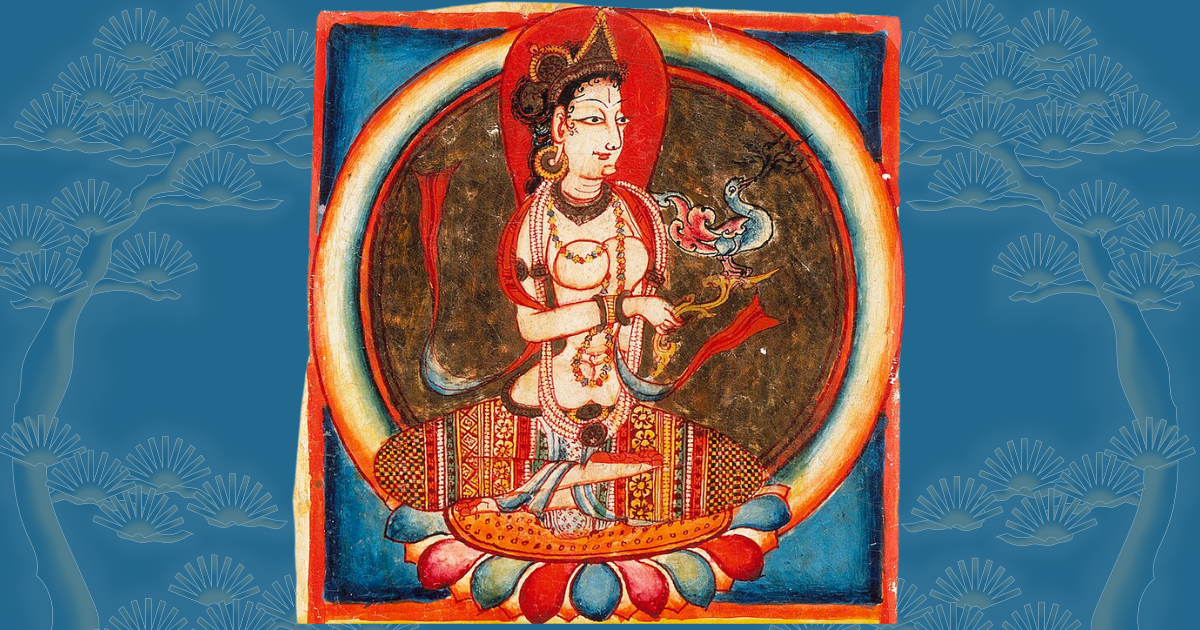
Illustration from a Prajñāpāramitā manuscript in one hundred thousand lines, public domain, via Wikimedia Commons.
The Perfection of Wisdom in One Hundred Thousand Lines is the longest of the Prajñāpāramitā sutras, twelve volumes in Tibetan and close to ten thousand pages. For the first time, it is now available in English, translated by Dr. Gareth Sparham.
In this conversation, Dr. Sparham traces the long road that brought him to it: more than two decades as a monk in India, years spent with the great commentaries, and a persistent doubt about where the words of the Buddha truly begin. He explores what the Perfection of Wisdom actually is, why a single teaching runs to one hundred thousand lines, and why anyone might read a text so vast when far shorter versions exist. And he turns to the heart of these sūtras: the way they dissolve every certainty, even their own. What remains when they do? It would be easy to hear that as a kind of emptying into nothing. What Dr. Sparham finds there instead is something else entirely.
You can watch the interview or read the transcript below.
(This transcript was edited for clarity)
My name is Mariana Restrepo, and I work on public engagement at 84000, helping people connect and relate to the Tibetan Buddhist canon.
Among all the scriptures of the Tibetan canon, one stands out for its vast scale. The Perfection of Wisdom in One Hundred Thousand Lines is the longest of the Prajñāpāramitā Sūtras, the Perfection of Wisdom Sūtras. It encompasses twelve volumes in Tibetan and is close to ten thousand pages, and for the first time this text is now available in English. I'm joined today by Dr. Gareth Sparham, who has worked for years translating this text. Dr. Sparham spent more than twenty years as a monastic and interpreter for Tibetan teachers before turning to a lifetime of work on the Perfection of Wisdom literature. Dr. Sparham, thank you so much for joining us today.
In the early 1970s, I had finished a degree in English, but I hadn't really identified a career that I wanted to spend my life in. So, like quite a lot of people at that time, I found myself heading off to India. I spent some time in Nepal, and I met some really wonderful Tibetan teachers there. But I had this doubt in my mind: what if I were to keep studying this? I also studied it in a way that somebody could say to me, "Maybe you don't think it's so good, but that's because you didn't study it in the right way." So I thought, “If I study it in the same way that my teachers studied it, then I'll be able to make my own decision about whether it's worth it or not.”
And so that meant I went to a school for Tibetan. There were only monks at that point; later, some nuns and some lay people came. I began studying then in the same way that my teachers would have studied. After about two years, we started a book. We had to memorize it, because it was classical old Tibetan. Even though I didn't really speak Tibetan well—I could hardly understand any—you could memorize the books, and the native Tibetan speakers were in the same boat. They hadn't got the slightest idea what it meant either. That book that I memorized was called the Abhisamayālaṃkāra in Tibetan. And that book is an explanation of The One Hundred Thousand, even though back in 1973 or 75 I hadn't the slightest idea that's what it was. You just memorized it.
So that's how I started, not knowing, in a sense, what I was doing. And perhaps like anything in life, it gets better and better, because you start to understand better and better what you're doing, and you meet good friends. That's really the essential thing. It doesn't need to be in a monastic school like I was, but you need good friends. That's usually the word we use. It can be your grandfather, your grandmother, all sorts of people who are good friends.
I met very good friends, and my Tibetan got better. But I had a doubt. A friend came on a Fulbright scholarship, and I'd been among them for about ten years, but I noticed that people really respected that fellow with the Fulbright more than me, who was really trying hard. So I thought, I'd better get a PhD here. And I was fortunate to have good friends in university too. I learned Sanskrit there. That original start in the Perfection of Wisdom, way back in 1972, 73, 74, I kept going at it. My dissertation was on a writer who was explaining the Eight Thousand Perfection of Wisdom, and at the same time I was working on the earlier texts that I'd studied in India. While I was doing my PhD, I also spent half the year on the west coast in Canada, at the University of British Columbia, but I still saw myself as living in that monastery in India. You have the two cultures slowly side by side, because of course I came into it with my own culture. But one way or the other, I made the Perfection of Wisdom literature my life since that time. Slowly, people get to know you're involved in it, and they approach you to translate the texts or do different things. So it's associated; it's my career, I guess you could put it.
I always like to say I backed into it. When we begin, we don't know what we're doing. We do what we find. And it can have tremendous psychological benefit. I like to think of myself as a basket case who needed those sorts of things back then, and needs them today. So certainly psychologically they're tremendously valuable to me. The systematic way in which the material is presented has a very real use for practice, for helping yourself mentally.
I'm talking now about myself in California, and here in Toronto. We're tremendously fortunate in terms of things for our physical well-being, but not culturally so much, at least for myself; not so many techniques to look after the inside world. In the commentaries, you get lots of those, systematically set forward. The words of the Buddha are very important; they're a given, they're there, and you'll have citations from them, but they will be systematized for you. It's not to say they're not what those words of the Buddha are saying. But if you just read the words of the Buddha, say you try reading The One Hundred Thousand—never mind the thing is ten thousand pages long—it's hard to immediately see how you're going to use that to help yourself psychologically, to have some mental exercises that will help you in your day-to-day life. So I like to say I backed into it.
In Tibet, as I'm sure you know, it's an incredibly rich culture, and like any rich culture, there's a tremendous depth of literature. You can't study it all at once. There'll be some people you're fortunate enough to meet, and out of the kindness of their heart, wanting almost nothing back, they will introduce you to their culture, probably as we would if somebody came and really saw the depth in our own things, be it Shakespeare or Cervantes or whoever it is. So it may look then that the commentaries are a long way away from the actual words of the Buddha. And there's a sense, as I said, that I backed into it. It doesn't really make sense to use a commentary before you know what it's a commentary on.
Especially when I began to do a PhD, the Western culture within which we're brought up is very chronologically oriented. You understand things in chronological order, and therefore you want to keep going back and back to get to a kind of beginning of it, an original of it, to want something authentic in it. Though I'm not strongly imbued with that, I grew up with it: the notion that somehow you have something authentic way back deep in the mists of time, and that if we research and learn, we will get back to something earlier. My PhD was on an Indian commentator on the Eight Thousand; he lived about 800 in the common era, and his works were already translated into Tibetan by then. There was a fourteenth-century writer who was important for the Tibetan people with whom I studied. I translated those works, very long, in four volumes. Then I noticed his work was based on these eighth-century Indians, so I translated their works. As you get to the eighth century, they're a little bit closer to the words of the Buddha; they're glossing them more closely than the Tibetan.
By this time I'd come back from India. I'd been there about twenty-seven years as a monk. I loved being a monk there. If you have the good fortune to be a monk or a nun, rejoice, absolutely rejoice in it. Nobody would ever give up being a monk or a nun; they just don't have the good fortune to continue in that life. I came back and got a job teaching at the University of Michigan and then the University of California, and that helped me while I was translating the Indian commentaries. And then there was this wonderful man Gene Smith. It was basically through him that I got to hear about 84000. I also knew the earlier editor, Tom Tillemans, who had been in India in the early 1970s. One way or the other, I got involved in 84000. The 84000, in its essence, is the words of the Buddha.
So I approached 84000 and said, well, I'll translate the earliest commentary I know, which you find in a catalog from about 825. That's actually published on 84000, the commentary on The Eighteen Thousand, Twenty-Five Thousand, and One Hundred Thousand. I thought, if I do that book, already translated into Tibetan in 825, I will have the very earliest Tibetan version of these words of the Buddha.
But I had a doubt. I thought the words of the Buddha would be in the Buddha's language, surely. And if they're in the Buddha's language, at the very least it would be in an Indian language. So why are we translating from Tibetan? That was my doubt. It was about two years before I got rid of that stupidity. The words of the Buddha are the words of the Buddha. It's not that there's no value in going back and finding the original words of the Buddha. But that's your problem. It's a good problem, a good doubt. It'll lead you into many interesting things. But no, that wouldn't have been the language of an historical Buddha. So within a year or two I understood that was not a big issue at all. It really isn't.
At that point I said, well, I'll translate The Eighteen Thousand Line Perfection of Wisdom. My rationale was that the oldest complete Perfection of Wisdom manuscript we have, the so-called Gilgit manuscript, is of The Eighteen Thousand. I thought I'd translate The Eighteen Thousand with that, and then I'll be sure I'm not getting too far, because you've got this thing about the words of the Buddha. And I in no way disparage the work of people who do that, going back through the languages and the manuscripts. Without that kind of scholarship, there can't be an 84000; there can't be the translation of these special books. But that's a different issue than trying to find the words of the Buddha, which is a complex issue. After eight, nine, ten months, I realized that was absurd too. They're different books in different languages, and they're equally the words of the Buddha. At that point, okay, now I understand. Translate the words of the Buddha.
Then I really did begin to finish the translation of The Eighteen Thousand with this commentary. And of course I've got all this commentarial literature, which is slowly beginning to be looked at from the other direction: instead of looking through the commentaries into the text, you're looking the other way. Then that was done, and then came The One Hundred Thousand.
Now that is an absolutely fascinating book. I did my original degree in English literature, and for me, a book's a book's a book. I don't care what the book is. But to call The One Hundred Thousand a book is absolutely mind-boggling. It's twelve volumes, each about eight hundred pages long. And yet it is worth taking it as a book.
Now the editorial issues become extremely huge here. Editors are of tremendous importance. I'm not an editor; I'm a translator, though I've edited other people's things. But the editor is of tremendous importance when you have a large project. And I will say this about 84000: the project has many people working together, often from different backgrounds and cultures, in a very harmonious way. That's always tremendously important in this world we live in. When you really start looking at the words of the Buddha, at The Twenty-Five Thousand, The Eighteen Thousand, The One Hundred Thousand, so many people worked on the books that gave rise to the Tibetan. There may indeed have been a human being, a Buddha, an enlightened being on Vulture Peak, one person saying everything, like I'm speaking right here. But in terms of the books, they are absolutely dependent on so many people, and importantly the people who sponsor it, the people who give to allow people like me to do the work. That's how it's been done, century after century, in different ways.
What you notice when you look at The Twenty-Five Thousand, The Eighteen Thousand, and The One Hundred Thousand in the Degé edition is that some of the editors working on some texts clearly were the same, and others were a bit different. You really have to have such respect for the editors. I've got my twelve, thirteen, fourteen, fifteen volumes, but the idea of having 108 of them, it just blows your head off. You can always find this fault or that fault. Anybody can find a fault in anything. Devadatta found a fault in the Buddha. But at the end of the day, the respect for the editors is incredible.
As I looked at The Twenty-Five Thousand, comparing the Sanskrit and the Tibetan, I said, my God, it's got to be almost exactly the same, but the way it's come out in Tibetan is slightly different in The Eighteen Thousand than in The Twenty-Five Thousand. It was clear that The Twenty-Five Thousand and The One Hundred Thousand were the same translators, the same editors. So it was very important in presenting the words of the Buddha to make similarities where they are between The Twenty-Five Thousand and The One Hundred Thousand, not slavishly. I never had the good fortune to meet the translator, Gyurme Dorje, but he had done a huge amount of that translation of The Twenty-Five Thousand, and other people finished it. Using that to make sure there were similarities in the English as there are in the Tibetan, that took me to the translation of The One Hundred Thousand. So that's the history of how I came to do it.
I think you've got two questions there. First, what is the Perfection of Wisdom? And second, why are there so many versions of it? For the first, we can leave the books aside for a minute. If you're lost, think: books. It's a book. It's a sacred book for many, many cultures. And certainly in Tibet, it's put above even a statue of the Buddha.
But what is the Perfection of Wisdom? It's a little disconcerting. Probably people know something like the Heart Sūtra, and maybe they've stuck their toe in the water of what we call Buddhism and heard about emptiness, and also that there's compassion, but especially emptiness. And it isn't without value to say that the Perfection of Wisdom is wisdom in the sense that when you say a person is wise, what they know is something gained over a lot of experience, something of value, rather than just knowledge. So by and large it's not a bad place to begin: the Perfection of Wisdom is knowledge of emptiness. If you read the beginning of the Heart Sūtra, it's something like, how does a bodhisattva practice the Perfection of Wisdom? How do you become wise? What do you have to know? And it's true, to use our translations, the physical forms are empty. It's always inward-looking, not navel-gazing, but looking in, and it's really deep.
The dharmas, it's incredibly difficult in these Perfection of Wisdom books to render this word dharmas, because we all know the Dharma, "Oh, the Dharma, yeah, that one." But what about the dharmas? By and large, looking inward means you're looking at dharmas. It means physical forms, not in a Cartesian sense, not like a doctor looking at yourself thinking My God, I'm sick, but embodied, realizing you wouldn't be there if there weren't physical forms, feelings, perceptions, willpower, all the things that come together to make you do what you do. All of those things—seeing, hearing, smelling—all that we're doing right now, those are the dharmas, and they are empty.
So it's absolutely true that the Perfection of Wisdom would be understanding that all those things are empty, because if they aren't there, what's there? Using the oldest foundational Buddhist categories, which are absolutely divine, there's no other way to put it, to get rid of your mental problems, you just do the oldest meditations on the five skandhas, the aggregates. Aggregates just means the great lump of them, which you are. The mental world is so huge for what we are. When you see, it's a huge part of you; when you hear, it's a huge part of you; when you touch things, especially touch, touches are so big, the body. And then the mind, sure, there's all sorts going on in the mind. Your head is so big, especially if you're an academic. That's the sixth faculty, the mental faculty.
So it's true that the Perfection of Wisdom is the emptiness of them all, and if you're putting your toe in the ocean of these books, it's a good enough place to begin. But to think that knowing that one thing makes the Perfection of Wisdom, it would not be perfect. Knowing one thing, even if it's the ultimate truth of everything, is not going to help you; well, it'll give you nirvana, don't get me wrong; it's incredibly important. But perfection means not just knowing all the basic Buddhist categories. It means knowing what you should say and what you shouldn't say, bringing so much into your life so that you can be of some value to others, how you get those things, having them, knowing what it's like to have them. Perfection means knowing all those things. That's why it's really long, with these lists. If you ever looked at The One Hundred Thousand, they've got lists to sink a boat. But why? Because that's the content of wisdom. All empty.
And here's my hobby horse, I can't help it, but I think I'm right. What's the most important thing? What's the one that everybody's marching out under, their religion, their teachers, their culture, especially their books, these incredibly important books? The odd thing about this book is it's in no way saying that all the different skandhas, all the different elements of a Buddhist teaching, are empty, so you don't need them. It's not saying that. Similarly with the book, it's not saying The One Hundred Thousand, The Twenty-Five Thousand, The Heart Sūtra, all the words of the Buddha, the teachers, are not necessary. It's just saying they're empty, too. And that leads you to what you learn when you first start. It must be compassion, altruism, a concern for others, that looks at the empty; If all that's empty, even the books, even the teachers, even the Buddha, everything… that also explains your second question, why there are different books: because there are different people. It's the ones for whom they are full that define them, not the content. In this empty world, the value they have for those who encounter them—that's a book worth reading. At least it is for me.
You couldn't say that the letter "a" isn't enough, funnily enough. In most of the Indian alphabets, and therefore the Tibetan alphabet, the consonant is revealed through the "a" sound. So the a is connected with each consonant, and in that sense becomes basic for any kind of sound. Based on the sound, you're going to have words; based on the words, you're going to get sentences, books, meanings. So a, in that sense, for the person who can understand it, there you go, you've got the whole book. If you're that person, go for it.
For myself, it was only once I had the incredible good fortune to be asked to translate it that I went through it from beginning to end. It would be incredibly hard to go through that book just reading it. I did it because I translated it. There's nothing like it, nothing like it. But for fools like me who can't understand why they'd let a, or The Heart Sūtra, or The Diamond Sūtra, or The Eight Thousand be enough, you do The One Hundred Thousand. Is it empty? It's all empty. But is there a heck of a lot that's empty? Yes. And it's not just some one thing. That's not enough.
It's enough for nirvāṇa. But even to get to nirvāṇa, you're going to need the so-called śrāvaka, the listener. So much of the Perfection of Wisdom is the basic Buddhism to get you to nirvāṇa. Without nirvāṇa, there's nothing for you; you're going to just suffer. Nirvāṇa and emptiness are the same thing, different words for the same thing in that sense. Nirvāṇa is getting rid of all the kleśa, the afflictive mental states, and the āvaraṇa, obstructions to knowledge. I've got lots of afflicted mental states; I would die for nirvāṇa. But unfortunately it doesn't work that way.
So what do you get from the long book? I think we have to be practical with ourselves. At the end of the day, you look at how much good fortune you have, how well you're doing. You're rich, or you're poor, you have your kids, or you don't, you have your dogs, or you don't, your body looks good, or it doesn't. You look at yourself, and you say, how can I help myself? For many, as the Perfection of Wisdom or most books say, I can't really change who I am like that; it's just not doable. I can do my meditations, but I'm still left with my problems.
So you can respect something like 84000 trying to get these words out. Why? Because maybe in your culture you learned they were important. They've been around two thousand years. It's not the only one; maybe other cultures have excellent things too, wonderful. If you have a little something, you can donate it so somebody can do something. If you don't, you can take something and write it out for yourself. And if you can, you can even read it. You don't need to read it, but if you can read it, you can ask somebody what it means. And if you can ask what it means, you can maybe memorize it. And having memorized it, from your memory you can say it out loud, with your articulation proper, and then you can begin to contemplate the meaning, and notice that there are words as well as the meaning of the words. You have the conventional truth as well as the ultimate. So there is the ultimate, but you have to remember the conventional, because that's where the compassion comes from. Looking at all those things, why are they there? They're there for the ones who benefit from them. You're not learning it for yourself. So, why one hundred thousand? It's a heck of a lot.
That's for sure. If you're talking about wisdom, you're talking about your intellect, your smarts, not getting taken to the cleaners. If you go and buy a used car, you've got your mind really there; you don't want to be robbed. Wisdom for that is good. But think of a child being read to. Is it valuable? Yes. Does the child actually totally know what's being said? No. "But you didn't get the word right. That's not how it's said.” You say, yeah, but we're not children. That's true; we're not. It's not exactly the same, but it's an analogy.
I would go to things, and the person would be talking in Tibetan, and I wouldn't understand a word. "Well, yeah, but I got the blessing." I can't say you didn't. The value is not the one you throw onto it; it's the one you find within it. If you don't know the language, it's hard. Fortunately, now some of these books are in English, and they'll be in other languages. Is it worth listening to somebody speaking in a language you don't know, if you think of what the book is? Definitely. Because you know that for two thousand years people said it, and slowly you get it, say in another language like English. It's a very sobering thought that you will treat those books in a language you use all over the place for so much, but you allow yourself to think it could be the words of the Buddha.
And if you hear somebody resounding it, you might even hear a bit. One thing's for sure: if it isn't read, you aren't going to hear it. It's so much easier if somebody's reading to you, especially if the person knows how to read it. And when you resound it, you give each page to a different person, and they all read it together. If some people hear it and they have faith in it, belief is important. It's an odd thing, but belief is a mental state. It's not the full end with the wisdom, but on the way to wisdom is belief. It can have the same content as the knowledge. Believing that the book has some incredible value when you haven't got the slightest idea what it's saying, you're lucky if you believe that. That sounds religious, so be it.
Say you believe that Darwin's explanation in The Origin of Species is a really good book. "Have you ever read it?" No. But you believe it's really valuable. And then slowly you go and try to read it, try to understand what exactly the issues are. There are so many things we believe in before we actually know them. How would I have got into it if I didn't think it had value? It's a belief, admiring it. I admired it because I admired the people. So there's a great deal of value in resounding it, but also in not being superstitious. Though superstition's fine, what's wrong with having joy in your mind? There's nothing wrong with that. But also knowing the value, working to try to understand the book, understanding the way it works.
If you've had the good fortune to be among Tibetans, it's the culture I know best, but one has certainly found it in people coming from other cultures too; you're definitely left with what the Abhisamayālaṃkāra, associated with the name of Maitreya, one of the explanations of these books, begins with. It begins with its famous lines, and the citta there is the citta in bodhicitta. The bodhichitta is a particular kind of altruism associated with these texts. An old translator, a wonderful man, Edward Conze, said, "lifting up your heart," or generating, producing a particular thought. You think a particular thought. You have tremendous admiration for yourself, within understanding your limitations. So you think the thought: I will make myself perfect. Samyak, I will make myself perfect. I will become enlightened. And then, for the sake of others. So that's what you're left with. There's nothing else there. Enlightenment is not even there. It's for the sake of others. And that is at the beginning of his book. His explanation begins with that. That's the one I had to memorize in 1973. The word at the beginning means desire. They must have used it, because desire is supposed to be bad in Buddhism, right? They must have used that word to show the power of the altruism of this thought that comes when you read these books. Everything's that vain, that empty. What we're doing really just dies with one eye. It's all gone. The worlds go away. Everybody running around working so hard at their religious things or their worldly things or whatever, all equally empty. Even the books, even the words one's saying, even the fact that everything's empty is empty.
That itself is not conveying, in and of itself, some final truth. So what are you left with? Well, everybody's got a lot of problems; otherwise why are they there? They are there saying that. Now, if there's anything of value for me, that is wonderful. And it's only for me that it's a value. Don't cause more trouble. If you make a problem with this one, there's no hope. This one becomes the one you're going to march under to battle; well, then you're finished. Because what else are you going to say? Even though you've said this one's empty, if you're going to march under it now, then you really are finished. What else can you do? So I think that's what you're left with. And it's incredibly moving.
You slowly do the different meditations, changing yourself into others, or the seven points, and you generate, or at least imitate, those kinds of ways of thinking, and you get tremendous feelings. But how that relates to the book, that's interesting. They say that fellow Asaṅga, you know, was busting his butt for I don't know how many years, and finally he sees this dog. And if you've lived in India, I lived in India twenty-seven years, you do see dogs with prolapsed wombs, bless them. They've had their puppies, and the womb can get infected. Can you feel sorry for anything? Is there anything that will make you feel sorry? I've got so many problems, I can't feel sorry for anyone. Something to make you feel sorry. They're great stories, you've got to admit. But how do you get that out of the book? That's why they're worth reading. When you see how that fellow, whoever Maitreya was or wasn't, the book's there, and he starts off that way. The way the books work is on the complex side, but you can't read them without slowly saying, "Oh, that's continually a leitmotif, that's continually there." And that's valuable for your own well-being. I always say it's a funny way to put it, but I made this promise to myself: if anyone is ever in a conversation with me and it brings up bodhicitta, that altruism, I'll immediately say thank you. So, thank you very much.
Click here to explore The Perfection of Wisdom Collection

Mariana connects diverse audiences with 84000's content in ways that are accessible, relevant, and inspiring.