Dr. Nathaniel Rich, one of 84000's editors of the Prajñāpāramitā Sūtra in Eight Thousand Lines, offers a scholar-practitioner's account of what the repetition, paradox, and relentless structure of these sūtras are actually doing to the mind that engages with them.
.png)
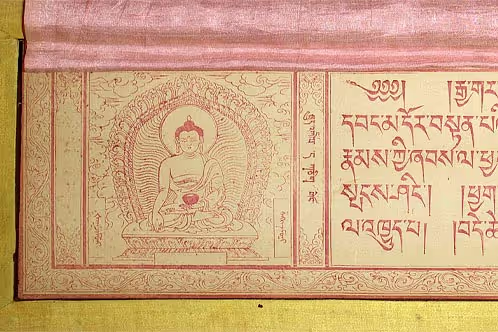
Painted covers and single folio from the Ashtasahasrika Prajnaparamita Manuscript. Nepal, 1511. Royal Library (Koninklijke Bibliotheek), Copenhagen. Public domain.
Before the recitation began, Dr. Nathaniel Rich, one of 84000’s two principal editors of the Prajñāpāramitā section of the Kangyur, offered a scholar-practitioner’s account of what the repetition, paradox, and relentless structure of these sūtras are actually doing to the mind that engages with them. In his talk, he reflects on what it means to work closely with these sūtras as both a scholar and a Buddhist practitioner: why the repetition is not incidental, why there is no philosophy in texts named for wisdom, and what it means to see “in the manner of not seeing.”
This presentation was recorded at Sravasti Abbey on Saga Dawa 2026, during the first complete English recitation of the Transcendent State of Wisdom in Eight Thousand Lines. The recitation marked the consecration of the Abbey’s new Buddha Hall and was conducted in collaboration with 84000.
This newly published translation was made by Dr. Gregory Seton under the Padmakara Translation Group, directed by Pema Wangyal Rinpoche and Jigme Khyentse Rinpoche. The text was subsequently edited by John Canti and Ven. Konchog Norbu, and published by 84000 as part of its Perfection of Wisdom collection.
You can watch the full talk below or read an edited transcript.
I am one of 84000's two main editors of the entire Prajñāpāramitā section of the Kangyur. What that means practically is that I am tasked with reading the Tibetan side by side with the English, and where possible or necessary, consulting the Sanskrit. An editor's primary responsibility is to scrutinize the translator's choices—ideally word by word and line by line—to verify their accuracy and desirability in English, their consistency, and to refine and even re-translate as needed. The goal is to ensure that 84000's translations are faithful to the Tibetan translations of the Sanskrit as they have come down to us.
As editor of the entire Prajñāpāramitā section, it is also my responsibility to think carefully about the relationships between the different sūtra, because while their topic is essentially the same across all of them, they can be very different from one another. The easiest illustration of that may be how much their length varies. The shortest is a single syllable—the syllable Aḥ—with a brief narrative introduction and conclusion, no more than a page. The longest, which I have spent a great deal of my time with over the last several years, is in one hundred thousand lines. That is not just the longest Prajñāpāramitā sutra; it is the longest scripture in any religious tradition in recorded human history.
We can roughly group these sūtras into three categories. There is the Aṣṭasāhasrikā in eight thousand lines, along with its famous verse summary, the Ratnaguṇasañcayagāthā. Then there are what are called the long sūtras: the Prajñāpāramitā in ten thousand, eighteen thousand, twenty-five thousand, and one hundred thousand lines. And then there are the short miscellaneous Prajñāpāramitā sutras, like the Heart Sūtra, which is by far the most famous. The Heart Sūtra is in fact a digest or essentialization of the long Prajñāpāramitā Sūtra—not just the heart of the transcendent state of wisdom as such, but in a sense the heart of those long sutras. It is in those long sutras that we first encounter the passage so familiar from the Heart Sūtra: form is emptiness, emptiness is form.
I want to set aside the academic perspective and share something personal about my encounter with these sūtras—as someone who has spent a great deal of time with them, trying to puzzle out what they mean and how that meaning is best conveyed in English. I was trained as an academic scholar and translator, but I am also a Buddhist, so this is one Buddhist scholar's view, offered humbly.
Buddhism is sometimes described as a philosophy rather than a religion. And if philosophy is the love of wisdom, you could be forgiven for assuming that sūtras named for wisdom—the transcendent state of wisdom, the perfection of wisdom—would be where you'd look for an explanation of Buddhist philosophy. But one of the first things you notice is that there isn't any philosophy in them. And I don't mean not really—I mean not at all. There is no logical proof, no rational demonstration, nothing we would recognize as an explanation of what emptiness means.
Not only that: if we come to these sūtras already familiar with Mādhyamaka philosophy, we might assume they are about emptiness. We will probably be surprised to discover that emptiness does not always take center stage. We are not simply told that everything is empty; we are also told that things are unlimited, that they don't arise, that they don't cease, that they cannot be apprehended, that they are pure from the beginning, like an illusion, like space. And even when we are told that things are empty, we are then told that it is a mistake to hold the notion that things are empty. What are we supposed to do with that? I think it is important to let that remain an open question.
The major formal feature of the long Prajñāpāramitā sūtras—and anyone who has spent time with them knows this well—is their use of repetition. In the one hundred thousand line version, the same list of dharmas or phenomena is repeated over and over again, relentlessly. By page one thousand, or five thousand, or eight thousand, an audience member asks a question, and the Venerable Subhūti begins to say "physical form"—and you already know he is going to do it again. Whatever the formula is, he will repeat it in full for every single item in the list, and then do it again. And again.
You cannot help but ask why. One thing I have learned from working closely with the Kangyur is that when you spend enough time with the sūtras, you begin to suspect that nothing is ever there by accident. Edward Conze, the scholar who produced the first English translation of the long sūtra, famously edited out these repetitions as inessential. He called them "drills." But if they were inessential, they would not be there.
So why are they there?
Here is my theory—I am not claiming this is right, but it is what extended time with these texts has led me to suspect. The list of dharmas being repeated begins with the five aggregates, then expands to the sense faculties and their objects, the contact between consciousness and those objects, and the feelings born from that contact. It is a systematic map of the constituents of ordinary experience.
The effect of the repetition is that the mind is constantly redirected back to those constituents. It is a little like the instructions for practicing mindfulness of breathing: you place the mind on an object, and every time it wanders, you bring it back. Reading the one hundred thousand line sūtra, every item unabbreviated, again and again—if you are paying any attention at all, you cannot help but have your mind constantly redirected back to the constituents of your own experience. And you are being told—perhaps even shown—that those constituents are empty, that they don't arise, that they don't cease, that they are like space.
At the opening of the long sūtras, once the vast assembly is gathered, the Buddha says to Śāriputra: Bodhisattva great beings who want to fully awaken to Buddhahood should persevere in the transcendent state of wisdom. When Śāriputra asks how they do that, the Buddha replies: They stay in the transcendent state of wisdom without there being any place to stay.
This is the kind of statement we encounter again and again in the Prajñāpāramitā sūtras. How does a bodhisattva who goes about life in the transcendent state of wisdom see emptiness? The answer: in the manner of not seeing. What does it mean to be in a state that isn't a state? To not apprehend anything? The bodhisattva does not apprehend "a bodhisattva," or "going about life," or "a transcendent state of wisdom"—and that is precisely how they go about life in the transcendent state of wisdom.
Wherever the mind lands or tries to land—whether inspired or cynical, clear or puzzled—what these sūtras are signaling at every turn is: that's not it. The point is not to form an accurate idea of what emptiness means. The point—which, not to be cute, is not a point—is a mind that doesn't cling, even to not clinging.
These scriptures do not explain that to you. They show it. They show how a bodhisattva sees in the manner of not seeing by inviting you—perhaps even forcing you—into a space where the ordinary mind finds nowhere to land, nothing to stand on, nothing to take hold of. If you think, "this is the transcendent state of wisdom," you have already lost it, or never had it. As the text puts it: those—the transcendent state of wisdom, a bodhisattva, the term "bodhisattva"—are all mere names. These names neither exist internally nor externally, and they cannot be apprehended in the absence of the two. So where can the mind settle down or dwell?
Working with these sūtras, it is impossible not to be struck by the history behind them. You are working with English translations from contemporary scholars. Those scholars are working from Tibetan translations of Sanskrit. Those Tibetan translations were made by master translators and scholars. And that Sanskrit goes back generation by generation, thousands of years. You can feel that lineage when you work closely with these texts—when you are trying, as best you can, to puzzle out what they might mean, imagining yourself into the position of those who transmitted them.
John Canti, 84000's senior editor and my collaborator on this section of the Kangyur, once shared a story he had heard from a priest who had worked as a missionary in the Middle East. The priest had stayed at a guesthouse and shared it with three Bedouin men who had never been to the city before. On the day they were to leave, the priest found them trying to dismantle the faucet from the sink. When he asked what they were doing, they said: We have never seen anything like this. This thing gives water. We are taking it with us.
They had no understanding of how the faucet worked. They only saw that it gave them water. What they didn't understand was that the faucet gives water only because it is connected to a pipe that runs all the way back to the source.
Transmission is like that. If there are blessings that come through these texts, it is because they are connected to a living transmission—one that goes all the way back to the source.

Dr. Nathaniel Rich is a research editor at 84000 whose work focuses on the intellectual and institutional history of Nyingma traditions in Tibet. He holds a PhD in religious studies from UC Santa Barbara and is actively involved with Dawn Mountain Tibetan Buddhist Temple and Research Institute in Houston, where his mentors first inspired him to learn Tibetan and support the transmission of the Dharma.