84000 copyeditor Ven. Konchog Norbu takes us behind the scenes of the editorial work that brings a sūtra to publication—the readings, revisions, and recitations that shaped our recently published English translation of the Prajñāpāramitā in Eight Thousand Lines.
As a Western monk unaffiliated with any monastic institution, and therefore responsible for my own support, I had long hoped to find work that aligned with my spiritual life. I followed 84000’s early evolution with keen interest, reading the sūtra translations as soon as they started publishing them. I’d always had a sharp eye for typos and found a few. Sending a shy email to 84000 to alert them to these began a conversation that, in 2015, led to starting contract copyediting on a text-by-text basis. I loved the work, and the 84000 editorial staff was happy enough with me that they offered me a full-time position at the beginning of 2018.
Early that year, the translation team held a meeting in Dordogne, France. One session was attended by Dzongsar Khyentse Rinpoche, Tulku Pema Wangyal, and Jigme Khyentse Rinpoche, 84000’s Founding Chair and two lamas who serve as our close advisors. At that session, I was introduced to the lamas and Jigme Khyentse Rinpoche asked me directly, “So, what does a copyeditor do, exactly?”
Swallowing my intimidation, I summarized for Jigme Khyentse Rinpoche that I understood my role not just as someone who knew how to deploy a semicolon correctly, but as the first experienced reader to encounter and respond to these canonical scriptures in English. Then I laid it out: I see editing translations of the Buddha’s teachings from the Kangyur as a sacred task, and follow the traditional approach of ensuring a positive intention, and internally supplicating the Buddha for his enlightened guidance. After that, I see to certain digital formatting of the translation in front of me, and then I read it twice. On the first pass, I tend to the fundamentals: spelling, punctuation, grammar, some syntax, checking for consistency with glossary entries, and ensuring overall compliance through all sections with The Chicago Manual of Style and 84000’s in-house editorial conventions. Often, I then present a compiled list of questions to the editor. Incorporating the answers to those, I copy the text into a clean document with all changes saved and read it again. This time, while certainly watching for basic errors I might have missed the first time, I read more deeply for meaning and feel. For the former, I rely on whatever Dharma education I’ve managed to absorb, including work on previous Kangyur texts, and I’m alert to what I call speed-bump moments—passages in the translation that somehow don’t seem fully accurate—and I leave margin comments about these for the editor to review. The latter—the feel—I also think of as the music of the text. How is the rhythm, the timbre, the melody? What would it feel like to recite this? The hope is that after all the polishing, it would be an inspiring pleasure.
After I finished, Dzongsar Khyentse Rinpoche made a predictably astute comment: “You know, maybe it’s better that you don’t know Tibetan and Sanskrit so well.” Of course he was right. While I have enough rudimentary understanding of the languages to spot glaring errors or ask the right questions, I don’t spend my time second-guessing the translator’s choices and digging into the source texts to see what I might choose instead. Rather, I do my best to help shape the translation primarily with future English-speaking readers and reciters in mind.
In my role as copyeditor for 84000’s translations, I’ve had many occasions to be deeply moved by passages in the scriptures that slide by on the screen, notably in recent years by those within the long Perfection of Wisdom sūtras. But I never thought I’d sit back and let out a long breath of amazement bordering on awe after reading the content of a colophon, until I encountered the one at the end of The Transcendent State of Wisdom in Eight Thousand Lines (hereafter the Eight Thousand).
A colophon is a brief statement at the end of a text giving some information about its production. In most of the Kangyur texts, these are only a line or two, naming the Indian and Tibetan translation partners, who usually rendered it from Sanskrit into Tibetan. After their work was complete, the text generally remained little changed to the present day.
But as the colophon in the Degé Kangyur version, which served as our primary translation source, reveals, this was not the case for the Eight Thousand at all. As the translator, Greg Seton, details in his introduction (i.20), after its original translation by three named translator-editors “and others” in the late eighth or early ninth century CE, the Eight Thousand underwent no fewer than seven revisions over the course of about 350 years, including by such luminaries as Atiśa Dīpaṃkaraśrījñāna, the eleventh-century Indian master credited with a revival of the Buddhist teachings in Tibet. Beyond that, further corrections were made to the Eight Thousand in other Kangyur collections, until finally, about seven centuries after the initial effort, Tibetan Buddhism’s collective scholastic community seemed satisfied with the result.
What struck me upon encountering this information was the exceptional care the upholders of the perfection of wisdom tradition took to ensure every single word of the translation reflected the intended meaning, indicating a particular reverence for the study and recitation of the Eight Thousand. I therefore felt an acute sense of responsibility as I approached the task of copyediting Seton’s translation in 2024, working closely with John Canti, our source-language editor for this project.
In some sense, I was in an editorial lineage of those who, for centuries, strapped original manuscripts and commentaries to their backs on the Gangetic plain and walked them across the Himalayas, in order to compare them in Tibetan temples with earlier versions, folio by folio, by the light of butter lamps, having new wooden printing blocks painstakingly carved if even a single error came to light. With that in mind, I felt I should probably be a bit more careful with my keystrokes.
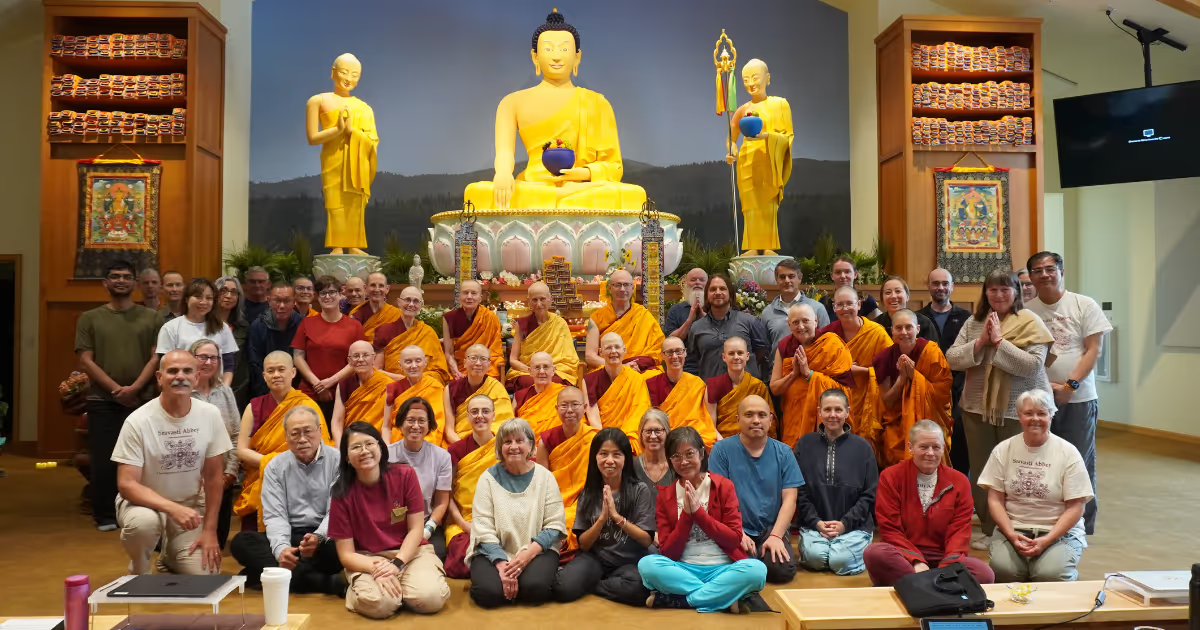
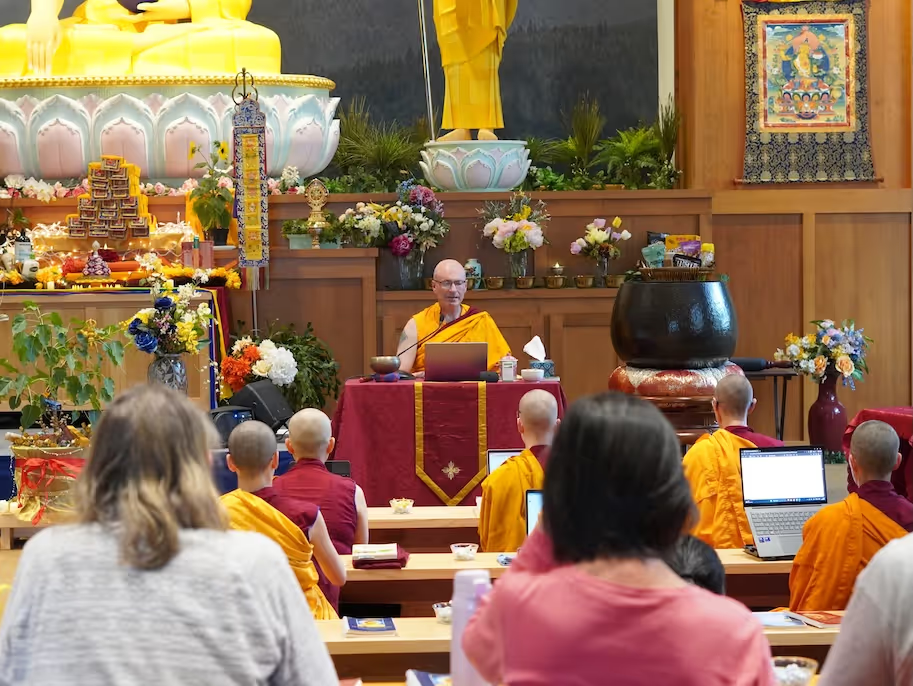
To add to the sense of personal responsibility, sometime earlier, when I learned that Sravasti Abbey in Washington was building a beautiful new Buddha Hall, I arranged to join their community and lead them in reading the finished publication of the Eight Thousand in its entirety—what 84000 calls a “resounding”—for the first time by Western monastics in their own language, as part of the consecration of their new hall.
The copyediting process got off to a rough start. For a variety of formatting reasons, the first copyediting pass was unusually challenging, so when I completed it, I decided to wait until it was available in our digital reading room before going through it again. By then, I had gained such a sense of respect for the Eight Thousand (and nervousness about a public recitation of it) that I dedicated six days between 2025’s Christmas and New Year’s to sit with this text in my shrine room. There, I recited the entire Eight Thousand aloud, carefully documenting every fine detail to adjust, and compiling a substantial list of questions to burden the editor with.
As expected, John responded to every question with just as much care. But this time, given the sheer volume of adjustments, I wasn’t satisfied with only two passes, and I resolved to read it aloud a third time over a long weekend in February, motivated also by the sūtra’s extravagant claims about the merit of doing so (for the curious, see chapter 5, “The Kinds of Merit”). All day and into the night, feeling the presence of Dharmataśīla, Rinchen Chökyong Zangpo, Jowo Atiśa, and Ngok Loden Sherab—some of the great translator-editors mentioned in the colophon—I strove for rigorous overall consistency and listened for the Eight Thousand to reveal its unimpeded eloquence, again and again.
But the complexities of preparing the Eight Thousand for recitation weren’t done yet. As the date for the resounding approached, 84000 simultaneously launched a completely revamped website, including a newly created PDF generator attached to all the translations. I opened the PDF for the Eight Thousand and…there were issues. Significant ones. Since this would be the file everyone would read from, I felt there was no choice but to quickly read through the entire text a fourth time, working with our tech director to fix glitches, which we managed to do just before I left to catch my plane to Spokane.
As a result of all this behind-the-scenes work, the resounding of the Eight Thousand in Sravasti Abbey’s Buddha Hall, attended by about sixty people on-site and hundreds more on YouTube livestreams of each of the twelve sessions from May 28–31, was considered by all a great success. And still, even after this fifth recitation, the reciters found typos and PDF anomalies, which have now been fixed, so now, hopefully, readers and future reciters will find this crucial text to be nearly perfect.
This newly published translation of the Transcendent State of Wisdom in Eight Thousand Lines was made by Dr. Gregory Seton under the Padmakara Translation Group, directed by Pema Wangyal Rinpoche and Jigme Khyentse Rinpoche. The text was subsequently edited by John Canti and Ven. Konchog Norbu, and published by 84000 as part of its Perfection of Wisdom collection. Explore our translation of the Transcendent State of Wisdom in Eight Thousand Lines, including the colophon, here.
If you ever want to conduct a guided recitation of the Eight Thousand on your own, or view the various talks that were given to support the resounding, you can explore Sravasti Abbey’s YouTube playlist from the event here.
For an extraordinary document of how Situ Paṇchen Chökyi Jungné compiled and edited the Degé Kangyur under royal patronage in the eighteenth century, see the third chapter of the catalog he wrote, The Third Well-Spoken Branch: An Exact Account of How All the Victorious One’s Teachings Extant Today in the Land of Snow Mountains Were Put into Print.
To dive more deeply outside 84000’s work into the Tibetan Buddhist process of translating and organizing sacred texts, see Kurtis Schaeffer’s The Culture of the Book in Tibet, Columbia University Press, 1989.

Ven. Konchog Norbu is a copyeditor at 84000 who studied modern American literature and creative writing at Brown University before becoming a Buddhist monk in 1993. He has worked for Lion's Roar, edited the teachings of contemporary Buddhist masters, and taught at Namdroling Monastery, where he oversaw projects of the Rigzod Editorial Committee.



.jpeg)