Artist and composer Harry Einhorn on how music, offering, and ritual can serve a practice rather than overtake it, and what it takes to reshape the Uṣṇīṣavijayā Pūjā for contemporary Taiwan without losing what makes it practice.
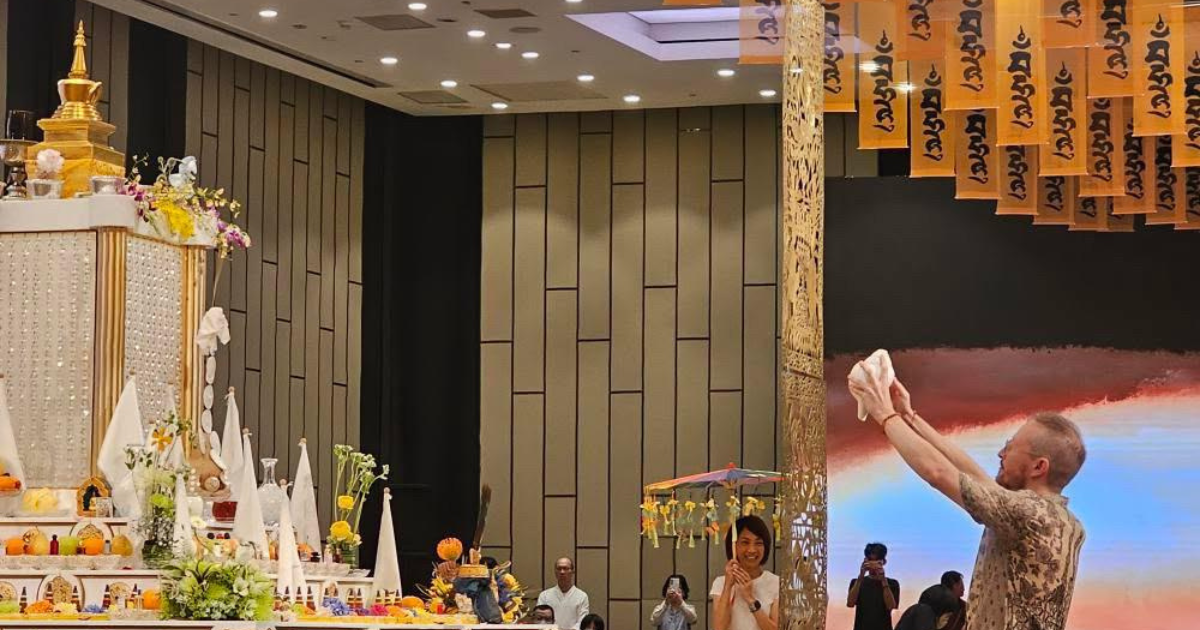
Harry Einhorn making offerings during the Uṣṇīṣavijayā Pūjā in Taiwan, 2025.
Every year for over a decade, a community in Taiwan has gathered to practice the Uṣṇīṣavijayā Pūjā. The practice is old. The way this particular sangha performs it is not entirely so. Under the direction of Dzongsar Khyentse Rinpoche, its shrine, its offerings, and its melodies have been gradually reshaped to fit a contemporary Taiwanese setting.
Harry Einhorn was asked to compose the music for the 2025 pūjā. An artist, composer, and educator based in Taipei, he took on a question that sits at the center of any living tradition: how do you introduce something new without overwhelming the practice it is meant to serve? In this conversation, he talks about writing music a large group can actually chant, turning performances into offerings, and why the Tibetan word for support, rten (pronounced “ten”), guided nearly every choice he made.
Mariana Restrepo: I’m Mariana Restrepo. I am the public engagement strategist at 84000. And I’m joined here today by Harry Einhorn. Harry is an artist, composer, and educator whose work ranges from lecturing on Tibetan iconography to co-curating and producing Dharma art at events like the Wonderfruit Festival in Thailand. Today, he's joining us to share his role in shaping the musical vision for the 2025 Uṣṇīṣavijayā Pūjā in Taiwan. Harry, welcome.
To begin, could you give us a brief overview of what the Uṣṇīṣavijayā Pūjā is?
Harry Einhorn: The Uṣṇīṣavijayā Pūjā is a Buddhist ceremony centered on chanting what's called the Uṣṇīṣavijayā dhāraṇī. You can think of the dhāraṇī as something like a longer mantra. It's a collection of sacred Sanskrit sounds and syllables found in a sūtra. The ceremony centers on chanting that dhāraṇī. It also includes ritual aspects, such as circumambulation around the main shrine and an element of offering practice. Offering is central to this practice; the Uṣṇīṣavijayā Pūjā is known to have a thousand different offerings. The dhāraṇī recited in this pūjā is historically associated with long life, abundance, good health, and also increasing wisdom.
Mariana: Can you tell us about that and what your role was?
Harry: Last year, I was asked to compose music and new chanting melodies for the Uṣṇīṣavijayā Pūjā, which has been happening in Taiwan for over a decade. I was also one of the chant leaders, in addition to playing some instruments live and through my computer. My job was to support this already well-established practice with a sonic environment to welcome people to make a deeper connection to the practice.
Mariana: Tell me about that process of coming up with music for a pūjā that, I’m assuming, being a traditional Tibetan pūjā, had very set melodies in the way that it’s done traditionally. How was it trying to come up with a different way, and what was the inspiration behind it?
Harry: Well, the Uṣṇīṣavijayā Pūjā—Siddhartha’s Intent Taiwan has been doing this under the direction of Dzongsar Khyentse Rinpoche for over 10 years. There's been a lot of hard work and dedication put into the development of this pūjā, and already, under his encouragement, there have been a lot of aspects that have been adapted to Taiwanese culture. Many of the design aspects, the way that the shrine has been set up, the way that the offerings are made, even what is being offered, are based on what the text prescribes, but have been adapted to a contemporary Taiwanese artistic setting. And that really can be attributed to the creativity and dedication of that Taiwanese sangha.
I’ve been living in Taipei for the last 6 years. So I was brought into a situation that had already been updated quite a bit. For example, during COVID, when we did the Uṣṇīṣavijayā Pūjā, travel restrictions meant no monks could come. At that time, the whole pūjā was already being done in Chinese, with some experimentation with melody, and the visual look had already been updated. I guess what I’m trying to say is that it’s not like it suddenly went from a Tibetan pūjā to something completely new. It’s over time, a process of iteration, a process of trial and error, and really a back and forth between the tradition and the needs and the habits and culture of the people where this practice and pūjā were being done. And of course, with the guidance, blessing, and inspiration of someone like Dzongsar Khyentse Rinpoche, to give us the confidence to do it this way.
Mariana: How do you approach the music itself, and what are you trying to accomplish with it?
Harry: For me, I start with the text, and it’s always a question of what is going to support the practice. It’s different from other types of artistic expression where, when I’m writing other kinds of music, or even some kind of visual performance, a lot of the time the approach is you start from some kind of personal inspiration. But here, when you’re writing for a big group, the first question really has to be: can people do it?
You have to think about what will support people’s practice, what will be inspiring, and what will be accessible. There’s always the risk that something sounds beautiful in your mind, but then people can’t actually do it, especially when you’re working with a large group who are often just showing up, with no rehearsal. It’s a very different approach. But at the same time, it’s important to create some kind of atmosphere. It’s really about creating an atmosphere, knowing the ritual and what it requires, and then thinking about how it will support people’s practice.
Mariana: Was there a point that you thought this was way too experimental, maybe you needed to scale it down a bit? Or did you feel the process was in tune with what the ritual required?
Harry: I like to move slowly, and I like to iterate, and actually, believe it or not, I’m a little bit conservative when working on big pūjās like this. And again, it always comes back to that question of what is going to support people’s practice. I mean, for me, I didn’t really look at this as that experimental, because Rinpoche has been encouraging us to create new melodies and experiment with musical accompaniment for a long time.
.jpeg)
Mariana: There were very beautiful performances during the pūjā by different kinds of artists. In such a context and setting, what makes something an offering rather than a performance?
Harry: Well, that was actually interesting because there was a certain moment when we had decided that the offering performances should be directed towards the altar instead of towards Rinpoche. That changed the entire atmosphere. We also requested everybody not to clap, and that actually really changed the atmosphere because, of course, when we’re offering to some kind of representation like a shrine or something like that, that’s also a symbol, but it also makes it more abstracted than offering to an audience or offering to a person.
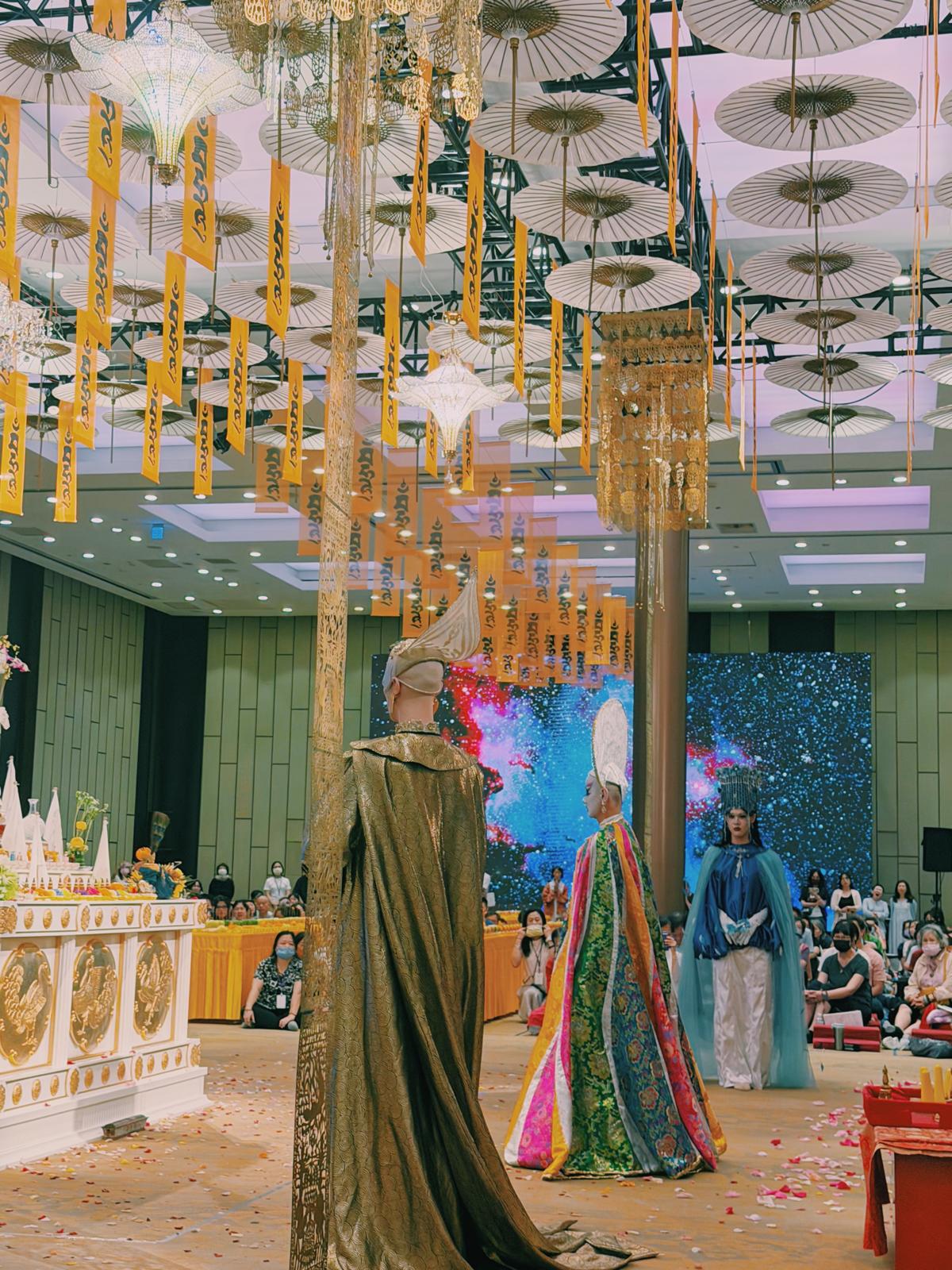
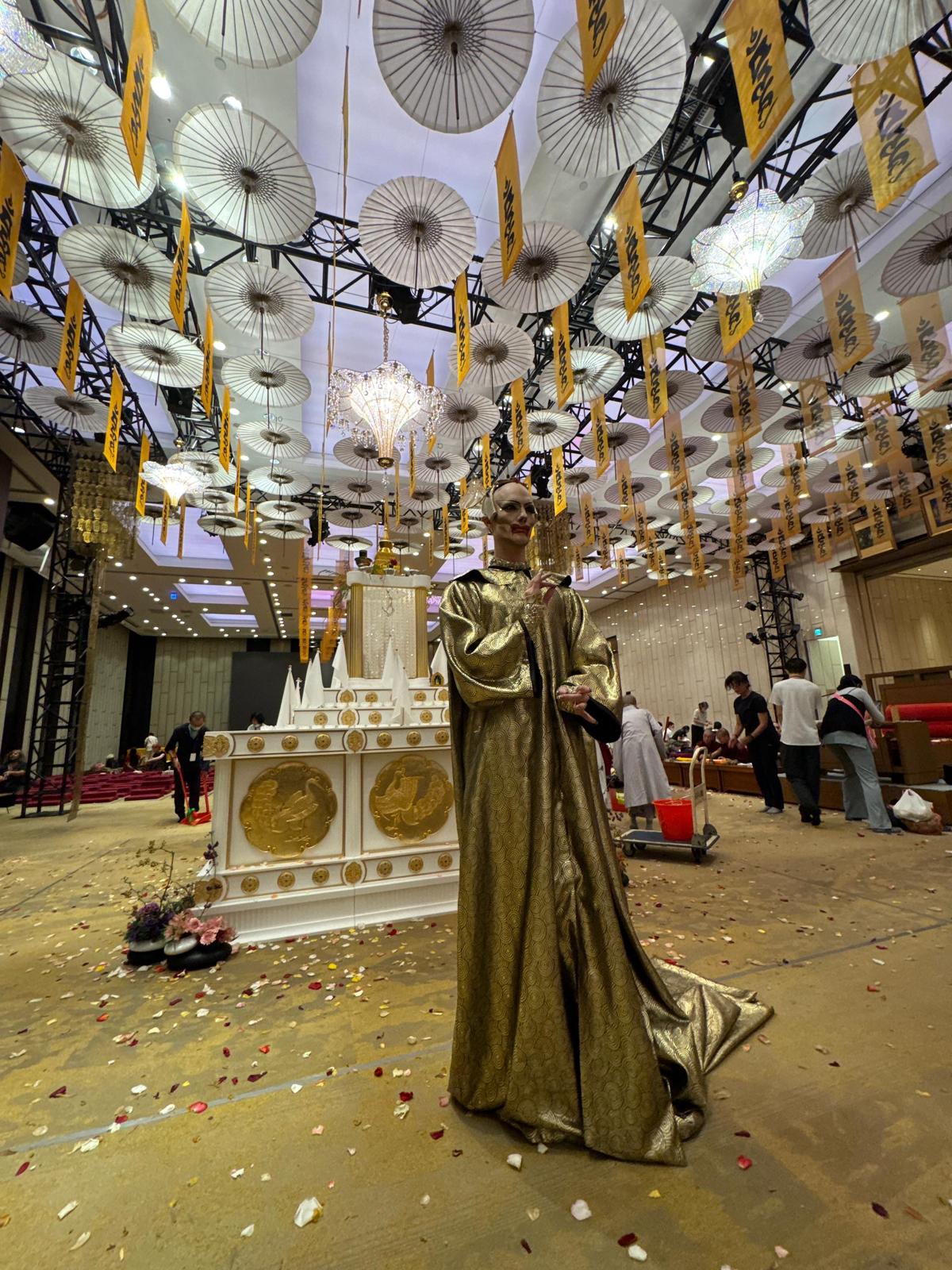
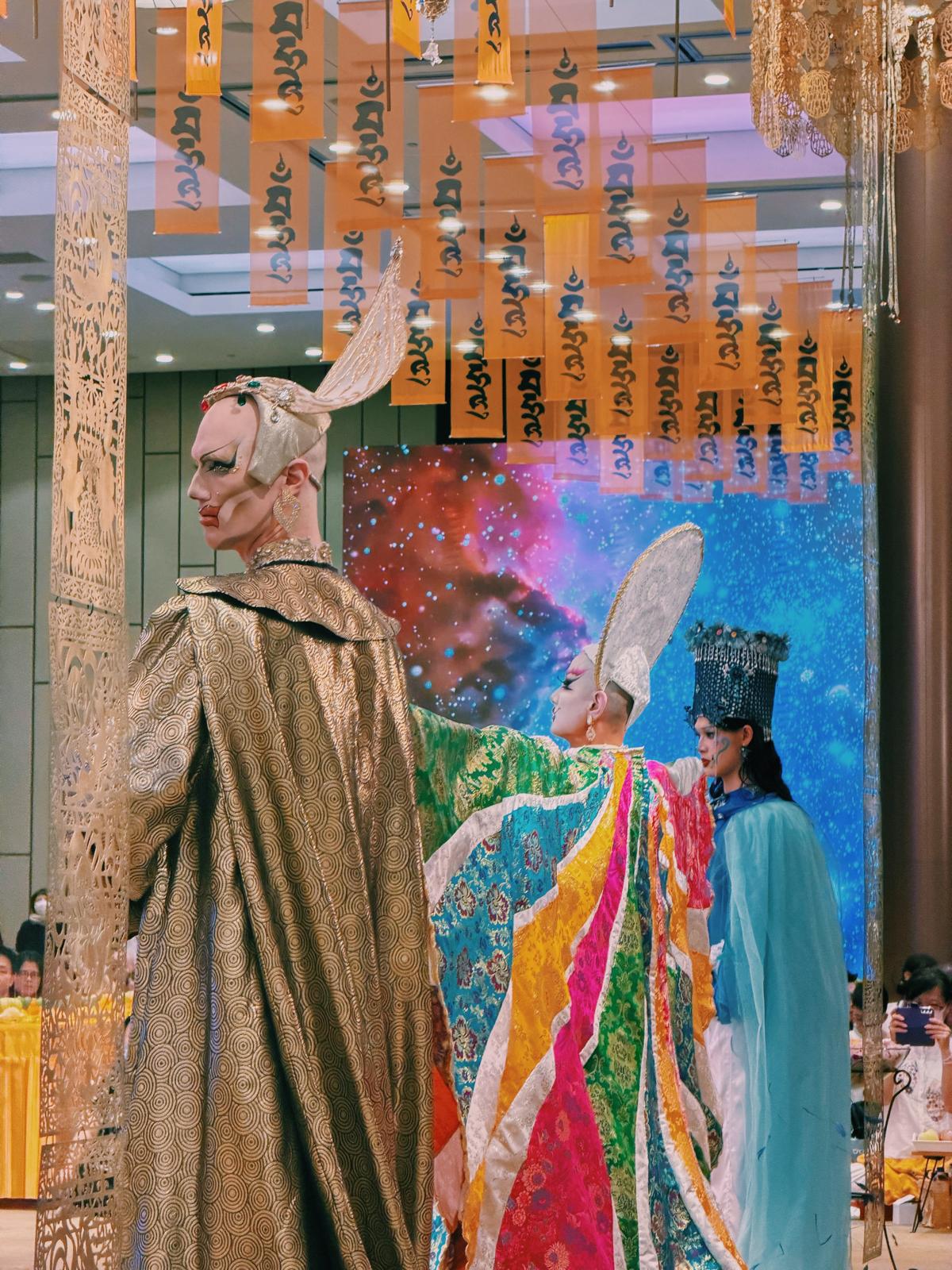
So I think it has to do with the attitude of the people making the offerings, the attitude and atmosphere of the people attending the pūjā, and also introducing new forms. For example, for one series of offerings, I invited a group of performance artists called Haus of Dimensions, who usually work in nightclubs as drag artists, to create an offering for the pūjā. I also commissioned an electronic musician from Sikkim, Yuhina, to create a rendition of the dharani. Though these artists were a bit non-traditional, I had been working with all of them for several years on other projects, so I knew they understood the sacred nature of the work.
The intention shouldn’t ever be to shock or push things forward for its own sake. Rather, it’s the question of finding relevant and innovative forms that the Dharma can take to help many different kinds of people relate to it. For example, in a very traditional setting, we know not to clap. If you’re in a temple, we don’t clap after the sūtra is chanted or something like that. And so when we are introducing new ways of making offerings, and maybe we’re doing something a little bit, you could say, exciting or a little bit lively, you do have to reintroduce a certain way of holding the container, so that actually we’re remembering that this is a practice, but at the same time, that practice can be joyful.
Practice can be exciting. Practice can be expressive, creative, and free. But then we're always, you could say, directing that kind of energy and excitement towards this intention, which is bodhicitta, and increasing and getting in touch with our wisdom.
Mariana: So much of this was about preserving the atmosphere of practice rather than performance. How did you help people understand that they are part of the pūjā, not just observers, not just someone watching a performance, but active participants in the pūjā itself?
.jpeg)
Harry: Well, we have a liturgy that people follow along. And many people have been coming to this pūjā for over 10 years. So the ground was really well established. A lot of people already know this practice. And so it is kind of important that when we’re thinking about things like music and visuals and the shrine, or really anything, it’s going back to the Tibetan word for all of these things, rten, which means support.
So it really has to support the practice. And I think just that collective intention of things can be rich and things can be new, and things can be creative, but it's always from that perspective of support as a base, rather than, you could say, overwhelming or overpowering. It’s that attitude: the role and participation of the practitioner is the most important thing, and everything is designed to support that.
Mariana: For someone who might be planning to attend the Uṣṇīṣavijayā Pūjā, whether in Taiwan or Canada or anywhere else, or maybe someone who cannot attend but would like to bring that mindset to their own practice at home—what would you recommend?
Harry: Well, there are several Uṣṇīṣavijayā sūtras available on 84000.co, and they include the dhāraṇī. The interesting thing about these dhāraṇīs is that anyone can do them; they don’t require initiation or any special teaching, and they are the words of the Buddha. The Uṣṇīṣavijayā dhāraṇī is incredibly powerful and has been treasured by emperors and educated people and farmers, by a whole range of people all across a huge range of the world for a really long time. It’s been carved on stone pillars. There’s even Uṣṇīṣavijayā Pūjā practice in the Theravāda tradition. And just saying the dhāraṇī, just reading it or looking at it, or printing it out and putting it somewhere, listening to it, just making some kind of connection, and just knowing that these are the words of the Buddha, that have been composed—or you could say, I don’t know if composed is really the right word, but communicated—it’s kind of unfathomable. But it's also fun to say, and I think developing some kind of enjoyment—that this is something that we like to do, this is something that we want to do, it’s something that brings us some kind of inspiration rather than it being some kind of solemn chore. Having that kind of excitement and joy also really helps. Just getting familiar with the dhāraṇī, I think.
Mariana: Thank you so much for talking with us.
Harry: You’re welcome.
The full 12th Annual Uṣṇīṣavijayā Pūjā, along with a playlist of the performance offerings, is available to watch on Siddhartha's Intent Taiwan's YouTube channel. We invite you to see the atmosphere Harry describes for yourself: the full pūjā and the performance offerings.
The Uṣṇīṣavijayā dhāraṇī survives in several related texts in the Kangyur, all available in the 84000 Reading Room. None requires initiation to read.
The Noble Uṣṇīṣavijayā Dhāraṇī That Purifies All Lower Rebirths (Toh 984). The most approachable entry point. It opens with the god Supratiṣṭhita confronting his own impending death and rebirth in the lower realms, and presents the dhāraṇī as remedy.
The Uṣṇīṣavijayā Dhāraṇī with Its Ritual Manual (Toh 594, 595, 596). Three closely related works, each pairing the dhāraṇī the Buddha Amitāyus teaches with short rites for its recitation. Translated by Catherine Dalton.
Ritual Manual for the Uṣṇīṣavijayā Dhāraṇī (Toh 598). A short ritual manual centered on the dhāraṇī's recitation.

Mariana connects diverse audiences with 84000's content in ways that are accessible, relevant, and inspiring.