
In the Amdo region of Tibet, three sūtras, The King of Samādhis Sūtra, The Perfection of Wisdom in Eight Thousand Lines, and The Good Eon, are recited together as a living substitute for the full Kangyur. Lowell Cook traces how this regional tradition formed, what it reveals about merit, recitation, and the karmic bonds between people and texts, and how it continues to adapt today.
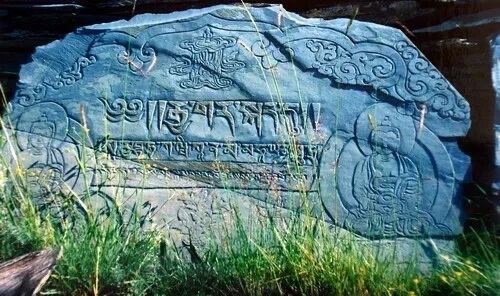
The Samādhi, Perfection, and Eon sūtras carved in stone at the Hor Chögar Monastery.
The Buddha is said to have delivered his 84,000 teachings with consideration for the varied interests and dispositions of diverse beings. Among his multitude of teachings, some scriptures were widely transmitted, while others gradually faded from view. A Multitude of Buddhas, for instance, was an incredibly popular sūtra in China, where it has been studied extensively, while in Tibet it did not enjoy the same acclaim, even if it was deeply revered. Behind the rise and fall of every phenomenon, Buddhist texts included, is an array of countless causes and conditions, the web of karma. In Dharma terms, there is a word that describes the specific teachings with which one shares a karmic affinity. That word is chökal.
Perhaps the best-known instance of chökal is the maṇi mantra, the karmically destined Dharma practice of greater Tibet. There is another unique karmic link between three specific sūtras and the northeastern region of Tibet known as Amdo. These three sūtras are The King of Samādhis Sūtra, The Perfection of Wisdom in Eight Thousand Lines, and The Good Eon. In Amdo, they are referred to by the shorthand as ting-phak-kal-sum or the Samādhi, Perfection, and Eon sūtras, using the first words of their titles.
While these classics of Mahāyāna literature have captivated minds across Buddhist communities for centuries, grouping them together as a set collection is unique to Amdo. These three sūtras are ubiquitous throughout the Amdo lands, and copies are found in many families’ homes where they are highly regarded for their protective and blessing power. It is not clear when the tradition of treating The King of Samādhis Sūtra, The Perfection of Wisdom in Eight Thousand Lines, and The Good Eon as a set group first emerged, though it must have been an organic process that occurred gradually over time. Though these three sūtras are often seen as linked with the Geluk masters and monasteries on account of their emphasis on exoteric Buddhism, the threefold category developed independent of any one particular teacher or tradition. This natural evolution of the Samādhi, Perfection, and Eon sūtras speaks to the different ways Buddhist texts resonate with different communities.
Over the centuries, these three sūtras were reproduced untold times in Amdo, often handwritten in gold and silver ink, fashioned into deluxe-edition manuscripts, or painstakingly carved into stone as a supreme act of merit-making. The path to awakening is said to require two accumulations: merit and wisdom. A Khenpo from Amdo once told me that while there are numerous ways to accumulate merit, the only viable way to accumulate wisdom, barring direct insight into emptiness, is to offer physical books of scripture, such as these sūtras. Years later, I discovered a passage in the sūtra The Collected Teachings on the Bodhisatva that says precisely this:
“Furthermore, when it comes to the accumulation of knowledge, there are four kinds of generosity: providing teachers of the Dharma with birch bark, reed pencils, ink, and books.” (11.107)
The translator here renders yeshé as “knowledge,” but it’s the same term we translate as “wisdom” above, just in a slightly different context—this refers to profound, awakened knowing.

In the Tibetan Buddhist tradition, housing a complete set of the Kangyur and reciting it in full each year has long been considered an act of great merit. In practice, however, given the sheer size of the Kangyur, historically only monasteries had sufficient means to commission copies of the Kangyur, the space to house its many volumes, and the monk—or nun—power to recite the Kangyur annually. This is one reason why certain scriptures, such as the Samādhi, Perfection, and Eon sūtras, came to stand in as symbolic substitutes for the Kangyur as a whole. In doing so, these three sūtras afforded individual households the opportunity to acquire, enshrine, and recite these texts as the very embodiment of the words of the Buddha. In the past, my friends from Amdo would tell me that it could be difficult for families to acquire the entire set of three sūtras. Some families might own a copy of only one sūtra, which they would lend out to other families when needed. In this way, these sūtras acted as a sort of spiritual glue that bound the community together.
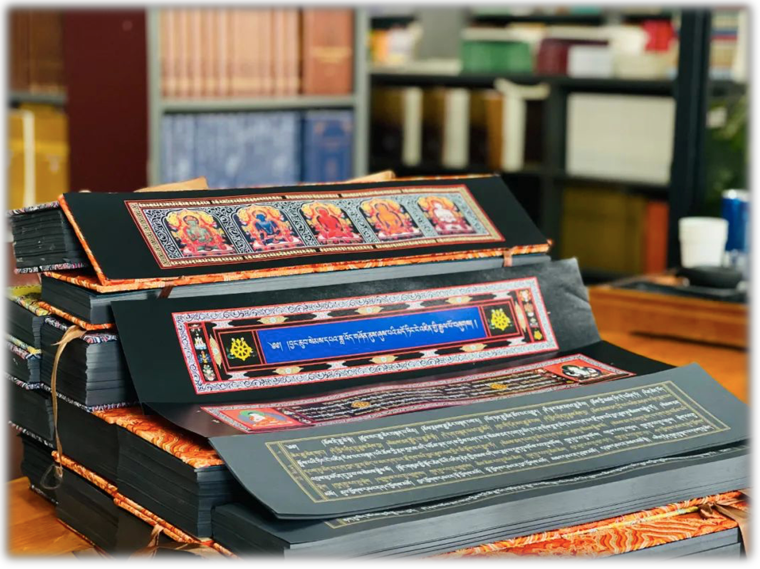
The reproduction of Mahāyāna scripture as a skillful means for merit-making is by no means new. Its origins lie in the rise of the Mahāyāna in India, where sūtras were not only texts used for philosophical and doctrinal purposes but also possessed a ritual and devotional dimension that centered on their material form as a site of meaning. We see this idea that physical scriptures can contain immense transformative power expressed throughout the Kangyur in exhortations to copy, own, and share sūtras. The following passage from the sūtra Teaching the Causes and Results of Good and Ill describes how reproducing and gifting sūtras actually aids one in understanding them:
“Those who delight in copying sūtras and giving them to others to read in this life will in all their lives possess great eloquence and will understand Dharma teachings just by listening to them once.” (1.33)
Even the mere presence of sūtras in the form of physical books is said to have the ability to bless, protect, and otherwise positively affect their physical environments. Of this transformative power, The Mahāyāna Sūtra “The Nectar of Speech” says:
“In whatever region such a sūtra as this is kept, wherever such a Dharma teacher dwells, or wherever this Dharma discourse is written down as a scripture—in such places all diseases, epidemics, harm, contagions, and conflicts will be quelled.” (1.12)
This is not to say that sūtras should go unread or be left to languish on shrines. Rather, this shows that Buddhist scriptures have multiple dimensions and are more than mere containers of information to be extracted through reading.
One way to understand how the reproduction of scriptures such as the Samādhi, Perfection, and Eon sūtras creates merit is explained by the editor of the Degé Kangyur, the 8th Tai Situ, Chökyi Jungné, in the fifth chapter of his Kangyur Catalog. The idea is this: The lasting happiness of buddhahood is reached in reliance upon the Buddha’s teachings, whose existence in this world depends on sublime masters to uphold them. Yet people can become genuine holders of the Dharma only through its study and practice, which, in turn, is possible only with access to authentic scriptures. Since our happiness and well-being are ultimately predicated on Buddhist source texts, Situ Paṇchen argues, there is nothing more beneficial and virtuous than reproducing them.
The recitation of the Samādhi, Perfection, and Eon sūtras is often performed annually in Amdo as a ritual to ensure that the new year brings both worldly success and spiritual growth. It is also recited at certain life junctures, during periods of difficulty, or at death to help navigate these transitions. Other times, astrologers may recommend reproducing or reciting three sūtras after consulting an individual’s astrological chart on the basis of there being a karmic link with these teachings.
A typical recitation in Amdo might look something like this. A group of monks arrives early at a family’s home, where they are welcomed with tea, a little tsampa flour, and lots of butter. They then unpack their texts and, after opening prayers of refuge and bodhicitta, set about reading the texts at lightning speed with each syllable clearly audible. The monks may read the same sūtra together or, if time is limited, each chant a different sūtra simultaneously. In the 84000 mobile app, the estimated reading time for The Good Eon in English is 74 hours and 42 hours for The King of Samādhis Sūtra, so being an articulate and speedy reader is important if they are to finish that day. As the sun draws overhead, their speed slows, and their enunciation grows less clear. The monks pause their recitation and take a break for afternoon tea and a lunch of “white foods” or meat-free dishes. Not lingering long after lunch, the monks return to the remaining sections of the sūtras and soon complete the recitation, dedicating the merit to the fortune of the family and the benefit of all sentient beings. More tea is served, the monks chat with the family about local events and mutual acquaintances, punctuated with Dharma teachings and life advice, before taking their leave. There is a flurried offering of traditional silk scarves containing monetary offerings, which the family insists the monks must absolutely accept despite their stubborn refusals. After the monks depart, the family relaxes, grateful to have had the words of the Buddha reverberate in their home, hopeful that the blessings will continue to echo throughout the year.
You may have noticed that the recitation was not aimed at understanding the three sūtras, but rather at intoning the raw sound to invoke the transformative power of the Buddha’s awakened speech. In the Buddhist tradition, one of the principles that allows for the efficacy of a ritual resounding like this is known as “declarations of truth” or satyakriyā in Sanskrit. A declaration of truth is a speech act or a performative utterance that is capable of having an apparently miraculous effect on relative reality via the truth naturally present in its statement.
Modern people might look disparagingly at this. What’s the point of mindlessly mouthing words or, as Tibetans would say, “a parrot mimicking maṇi mantras”? Though the recitation of the Samādhi, Perfection, and Eon sūtras does not require an understanding of their content, neither is it completely divorced from the sūtras’ meaning. The semantic fidelity—that is, how accurately the texts have been transmitted—underpins the efficacy of the ritual recitation. Chanting a version of these three sūtras that has been garbled (whether by scribal errors, printing defects, or, dare we say, artificial intelligence) could severely impair the efficacy of the ritual. This is one reason why Tibetan editors like the 8th Tai Situ painstakingly checked and rechecked the Kangyur texts to prevent as few errors as possible from creeping into them over the centuries.
The Samādhi, Perfection, and Eon sūtras show us how the transformative power of the Buddha’s speech can be accessed in multiple ways, only one of which is reading in the conventional sense. Monasteries, families, and communities across Amdo continue to reproduce copies of these sūtras to gather the two accumulations of merit and wisdom. They still turn to the ritual resounding of these sacred texts and their transformative words every year, like an old friend, both in periods of joy and times of difficulty. These sūtras and the communal rituals that put their truths into motion create the bond and reinforce a shared Buddhist worldview in the community.
The endurance of this tradition is due in part to its ability to adapt to an ever-changing world. Nowadays, in the markets of Amdo, you can find copies of the Samādhi, Perfection, and Eon sūtras mass-produced in exquisite deluxe edition sets. You can also find sound boxes with recordings of sūtras that can be played on endless repeat in one’s home. Technology and the rapid rate of change it brings with it are unavoidable, yet Buddhism has a long legacy of using the skillful means inherent in change to adapt to new circumstances and conditions.
Impermanence brings with it both gain and loss. Thanks to the efforts of 84000, soon everyone in the world will have access to the Kangyur in English, in full and for free. Though we may gain greater accessibility to the Buddha’s teachings, we may also risk losing a sense of their preciousness. For modern people inundated with endless streams of information online, a digital Kangyur may not inspire the same devotion that carefully crafted volumes of sūtras did for past generations. Yet, at the same time, technological developments are also opening up new avenues for the reproduction and recitation of sūtras. Copies of the Kangyur and Tengyur, among other Buddhist texts, have been laser printed on nickel and interred on the moon through the Arch Lunar Library. Practitioners all over the world regularly gather on Zoom to resound 84000 translations. Recently, The Transcendent State of Wisdom in Eight Thousand Lines was resounded at Sravasti Abbey and live-streamed on YouTube.
Technology and other conditions will determine which sūtras naturally rise or fall in popularity. The renowned translator and 84000 advisor, Erik Pema Kunsang, once remarked that the aspirations of translators are among the major factors that lead some scriptures to become more prevalent in some places and less in others. Again, it is the interdependence of karma and aspirations that creates chökal, the bonds and links between people and these sacred texts. With time, new groups of specific sūtras in English translation will surely become cherished by global communities. Thus, while the practice of reproducing and reciting 84000 sūtras may look vastly different than that of the Samādhi, Perfection, and Eon sūtras in the remote yak-herding communities of Amdo, the fundamentals will remain largely the same.

Lowell Cook has translated for 84000 since 2016 and joined as an associate translator in 2023. Lowell produces the initial translations of the sūtras, tantras, and other texts in the Kangyur.